When a tree is down or dangerous in Hoffman Estates
Is a fallen tree an emergency?
A tree on the house, a car, or a path people have to use is a call now. A tree on a line is 911 first if anyone is hurt or a line is down, sparking or burning, then ComEd at 1-800-334-7661, then us. A tree down in the back of a lot with nothing under it has more time. Stay back from anything that could still move, keep people and pets clear, and take photos from where you stand. For the next steps, our emergency and storm work page covers what we do when we get there.
A limb is on the power line: what do I do?
Treat it as live and stay back. If anyone is hurt or a line is down, sparking or burning, call 911 first. Then ComEd asks anyone who sees a broken limb lying on a power line, or likely to fall on one, not to touch it and to report it at 1-800-334-7661.1 We come for the tree once the line is safe.
Is it safe to stand under a cracked tree?
No. A trunk with a long crack, a split fork or a limb hanging from a torn join can let go in calm air, not only in a wind. Keep people, pets and cars out from under the full drop zone and call. The after-a-storm checklist runs through what to look at and what to leave alone.
Can I cut up a fallen tree myself?
No. A fallen tree is often still loaded: limbs are under tension and the trunk can spring when cut. Leave it where it lies, keep people clear and call us.
Trimming, removal and stumps
What is the difference between trimming and pruning?
In practice, people use the words the same way; the trade uses pruning for the thought-out cuts that shape a tree over time, and trimming more loosely for taking length off branches. Either way it is cuts at the right place on the branch, not shearing. The trimming and pruning page has the detail on what comes off and why.
When should oaks be pruned?
Not in the warm season. The Morton Arboretum says oaks should not be pruned between mid-April and mid-October, when fresh wounds attract the beetles that carry oak wilt spores, and the safest time to prune oaks is early November to very early April.2 A dead, broken or hanging oak limb that is a hazard comes off when it has to; routine oak deadwood waits for early November to very early April.
How do I know a tree has to come down?
A tree with no live crown this spring, bark falling off in sheets, a long split running past the main fork, or a lean that got worse with soil lifted on one side are the clearest ones. A tree with scattered dead limbs and a full green crown is usually a prune, not a removal. Our dead and dying trees page and the assessment page sort out which it is.
Is stump grinding part of a removal?
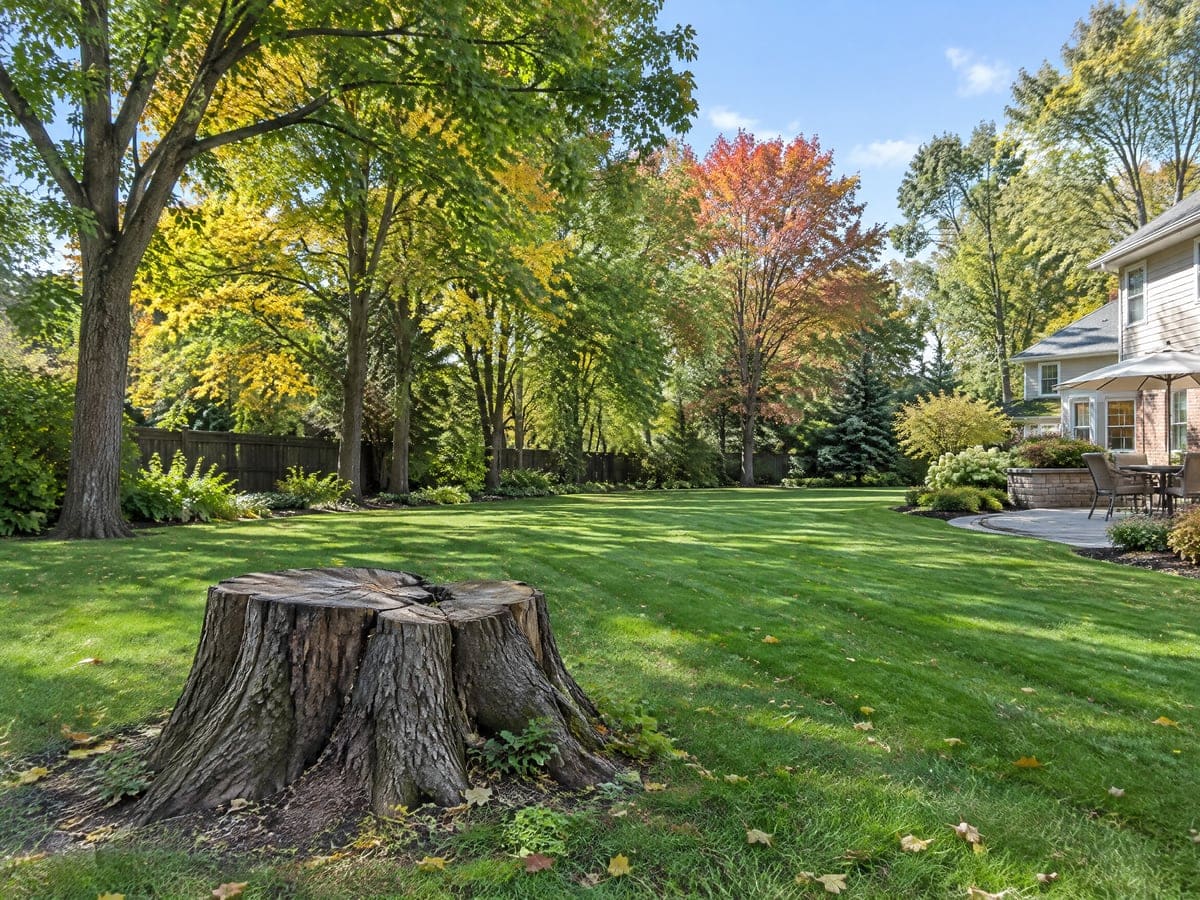
The stump is agreed with the rest of the job: it can be ground flush, taken a few inches below the grass or ground deeper for sod or a replanting. The stump can also be left. See stump grinding for what moves the price.
Can I grind a stump myself?
Leave it to a crew. A grinder throws chips and stones and can kick on a root, and whoever digs or grinds makes the JULIE request (811) at least 3 days ahead.3 On our jobs, we are the ones who call JULIE and work the grinder.
What happens to the wood?
That is up to the homeowner. Say on the call whether you want logs kept on the lot or everything hauled.
Costs and decisions
How is tree work priced in Hoffman Estates?
The height, the lean, what the tree would land on if it moved, how the yard can be reached, and the stump all go into the number. For each driver, see the tree service cost guide.
Is there a cheaper time of year?
Weather and schedules change through the year, but no month is reliably cheaper. For oaks there is a reason to wait: the Arboretum's oak pruning window keeps most oak cuts in late fall through very early spring. For dead or dangerous wood, call when you see it, not when the calendar says to.
Does homeowners insurance pay for tree removal?
That depends on the policy and what happened. Policies cover different things and have different limits for a tree that fell on a structure, a tree that fell with no damage, hauling the debris, and a tree that was already dead before it fell. Ask your insurer directly and take photos before anything moves.
Is there free tree removal for seniors?
The Village says trees on private property are the homeowner's responsibility, and points residents to a private contractor for removal or trimming.4 Parkway trees are the Village's to look after, and ComEd clears around its own lines. The free tree removal guide sorts out what the Village and ComEd really take on, and what stays with the homeowner.
Tree rules around Hoffman Estates
Who owns the tree between the sidewalk and the street?
The Village. Parkway trees are owned and maintained by the Village, trimmed on a four- to seven-year cycle, mostly in late fall and winter. Residents should not trim them, and removing one needs the Director of Public Works. The full picture is on our tree rules page.
Do I need a permit to remove a tree?
That depends on where the lot is. The code's 3-inch tree removal permit rule in Section 10-4-7 applies to land other than developed detached single- or two-family residential lots under one acre, and to any right-of-way removal.5 For a specific address, ask the Village's Development Services.
Will the Village take my branches?
Within limits. Branch pickup runs by zone twice a year and takes brush up to 8 inches across and 10 feet long, no stumps, root balls or firewood.6 Yard waste runs April through November with bundled brush. The Village does not take trunks or stumps.
Who trims near power lines?
ComEd on its own equipment. For trees between poles on your property, the Village refers residents to ComEd's Tree Trimming Assistance program.7 For the service wire that runs to your meter, ComEd will drop or de-energize it at no charge so your contractor can trim near it, scheduled through 1-800-334-7661.
Reaching us
What should I tell you about the tree?
A short list of details helps: what the tree is doing, the species if you know it, roughly how tall it is, what stands under it, whether a line is near it, and how wide your gate is.
What should I have ready?
A rough height, a rough trunk width, the species if you can tell, what stands under the tree (house, garage, fence, cars), whether a line is nearby, and how we would get into the yard. Photos from where you stand help; climbing to get a better angle does not.
How soon can someone come?
Schedules change with what is on the yard this week; say so on the call if the tree is unsafe, and we say when we can be out when we get back to you.
Can I leave my number instead of calling?
The call button is first on every page, and the callback form is right under it for the times a phone call is not easy. We get back to you either way.
Do you spray or treat trees?
Chemical tree treatment is a separate trade from tree work.
If a question is not here, call (847) 201-4879 and ask. If a tree is down or a limb is on a line, make the safety calls first and then call us, or leave your number in the form below and we will call you back.