Height is one of the drivers
Two 40-foot maples can be priced very differently. One stands in the open middle of a back lawn, with nothing under it. The other hangs over a house, a fence and the neighbor's shed, with a service wire running through the lower crown. The two are different jobs even at the same height.
Trunk width goes with height. Two trees of the same height can carry very different amounts of wood, and the thicker trunk is a larger piece of work than the slimmer one in the same yard.
Access is part of the price
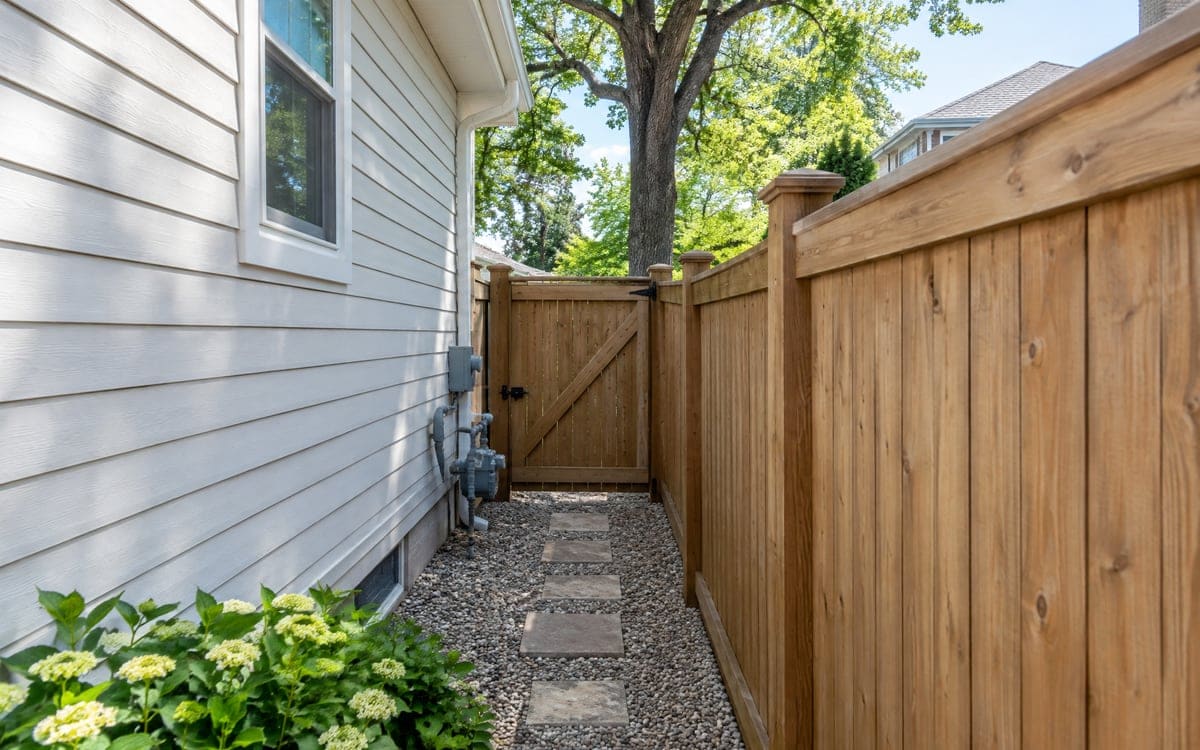
A tree in reach from the driveway opens the yard up; a tree behind a 10-foot gate narrows what fits. Reaching one on an open front lawn is a different piece of work from reaching one in a tight back lot with a narrow side yard.
Dead wood changes how a tree comes down
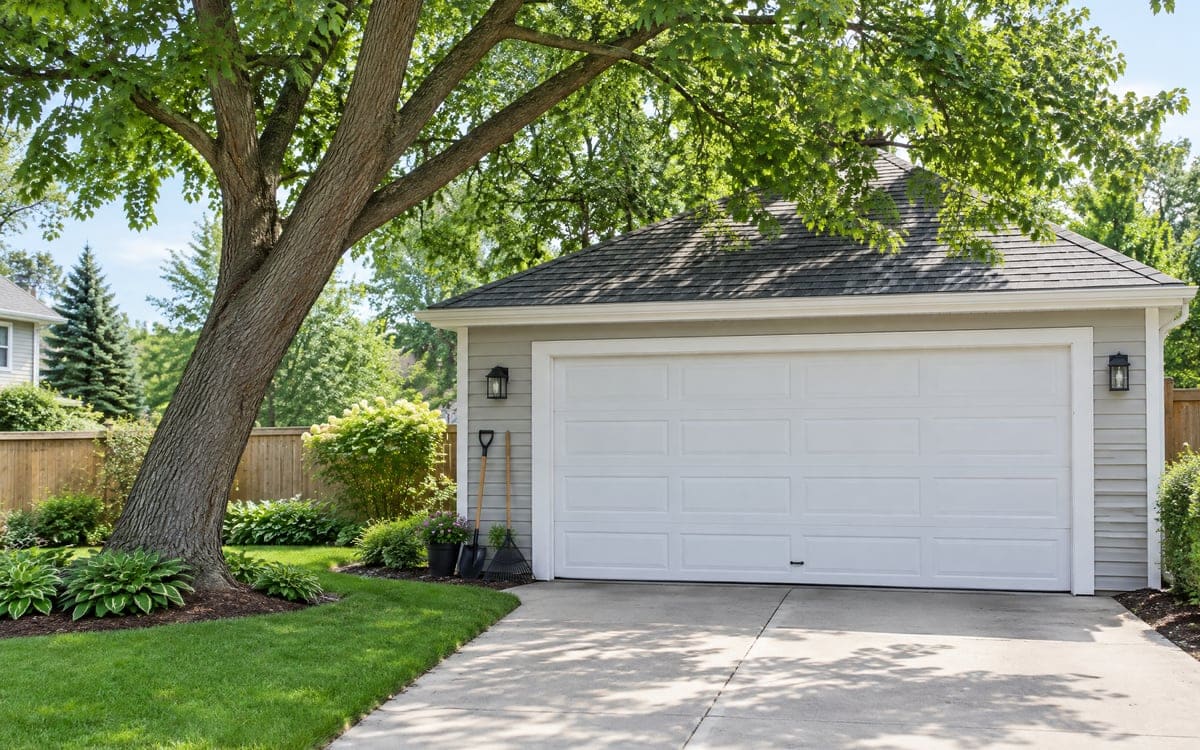
A live tree bends and holds together while a cut is made. Dead wood snaps, and in a windy week the pieces are unpredictable. A dead ash with the bark falling away is a different job from a healthy green one of the same size, because the wood above every cut has to be treated as if it could break without warning.
The Village says more than 6,000 ash trees have come out after emerald ash borer, substantially finishing the ash removal round,1 and the Morton Arboretum says emerald ash borer attacks healthy ash of any size, and infested trees may die within two to four years.2 An ash caught earlier in that window is a different job from one left standing dead through a winter. The condition of the wood goes into the number.
The stump is one of the drivers
It needs its own locates: the law requires anyone planning outdoor digging, whatever its depth or size, to notify JULIE at least 3 days before digging,3 and the person doing the digging makes the request. For a crew grind, that falls on the crew.
The main drivers on stump grinding are the stump's diameter, how far the surface roots run, how tight the access is, and how many stumps are grouped. Leaving the stump in the ground after a removal does lower the removal quote, but the stump is still there to think about later.
The wood plan is the homeowner's
Hauled away, left in rounds for firewood, or chips kept and raked into a bed: the decision is the homeowner's. Say on the call which fits the yard.
Village pickup takes some of the smaller pieces: branches, shrub trimmings and similar brush up to 8 inches across and 10 feet long,4 but not stumps, root balls or firewood. Yard waste5 takes smaller bundles under 50 pounds, 5 feet long and 24 inches across, with no limb thicker than 3 inches.
What the Village takes at the curb, and what it does not
Branch pickup and yard waste take the small brush from a tree job; the heavy pieces are a different route.
What the Village takes at the curb
- Branch pickup takes brush up to 8 inches across and 10 feet long, with willow kept separate.
- Yard waste takes bundles no more than 50 pounds, 5 feet long and 24 inches across, with no limb thicker than 3 inches.
What neither program takes
- Stumps
Sources: Village of Hoffman Estates, Branch Pick-Up Program; Village of Hoffman Estates, Yard Waste Programs.
Pruning price drivers
Pruning work is driven by the tree, the yard around it and what the cuts are for. A tall oak with scattered deadwood, a crown that has grown lopsided, and a few low branches over the driveway are three different jobs.
A pruning quote also considers the cleanup: a pile of soft green branches is simpler to clean up than a tangle on a fenced-in slope.
Storm work is priced on the same things, plus the risk
A tree hanging on a roof after a wind event is priced on everything above and one more thing: the risk that the tree is still moving. A split trunk under tension cuts differently from a stable one. A limb hung in the crown has to come down before anything under it is touched.
Storm damage changes the number because the tree is not stable the way a healthy standing tree is.
The ComEd service wire drop is free
Where a tree reaches the service wire from the pole to the meter, there is one line a homeowner does not pay for. ComEd says it does not do non-emergency trimming around the service wire, but if a homeowner or their contractor trims there, ComEd will drop or de-energize the wire at no charge and reconnect it afterward, scheduled through 1-800-334-7661.6 The drop and reconnect are free; the trimming done while the wire is clear is a private job.
For a tree between the poles on your property, ComEd lists three routes: its own line clearance crew clears around the lines so a private contractor can finish, a free line maintenance investigation to see whether the line can be de-energized, or a private contractor whose trimmers are line clearance qualified under ANSI Z133.1 at the owner's cost.6 Which route fits depends on the tree and what the investigation finds.
A parkway tree is the Village's
A tree in a private yard is the homeowner's to decide about. A tree in the parkway strip between the sidewalk and the curb belongs to the Village. The Village code allows a street tree to be removed only by Public Works, by a Village contractor, or under a permit from the Director of Public Works;7 the permit application calls for a written reason, approved driveway and building permits, and a Village review and site inspection. If a permit is issued, the permit holder pays for removing the tree and stump and restoring the parkway grade and turf,7 and a replacement charge applies by trunk size.
Section 10-4-7 of the code adds a 3-inch tree removal permit rule that reaches land other than developed detached single- or two-family residential lots under one acre, plus any right-of-way removal; the full text is on the tree rules page.
Ask Public Works before any plan on a parkway tree. The tree rules page sets out what the code asks for.
Reading a quote line by line
A quote worth paying is one the homeowner can read back. These are the lines that help:
- Which tree, by location on the lot, and species where known.
- Full removal, limb removal or trim, per tree.
- The stump: ground, left, or ground deeper for sod or replanting.
- Access through gates and across the yard.
- Who makes the JULIE call when any digging is involved.
- Any limb close to a line, and the plan for the wire.
A quote missing one of those lines is a quote with a question on it. For the longer version of each line, the tree removal estimate page covers what the writing should say.
A low quote deserves one more question
If a quote comes in well below the others, the question is what it leaves out. That often means the stump, the haul, or the JULIE call before any grinding. Checking the company behind a quote is the way to find out which of those lines is missing before the saw starts.
Sometimes the low quote really is the better one, because the crew knows the yard and sees a cleaner way to the tree. Sometimes it is a different job on paper from what the other crews quoted. The homeowner is the one who makes the trade.
What moves a tree price
| Factor | Why it changes the work | Where it shows up |
|---|---|---|
| What stands under the tree | A clear drop zone is a different job from a tree over a house, a fence or a wire | Removal, storm work |
| Access to the yard | A side yard a crew can walk through changes the plan | Every job |
| Live or dead wood | Dead wood breaks without warning | Removal, especially of ash and elm |
| The stump | A separate JULIE request, and a different piece of work | Stump grinding |
| The plan for the wood | Haul, firewood rounds, chips kept on site | Removal, storm work |
| Season for oaks | The oak pruning window changes when the cut can happen | Trimming |