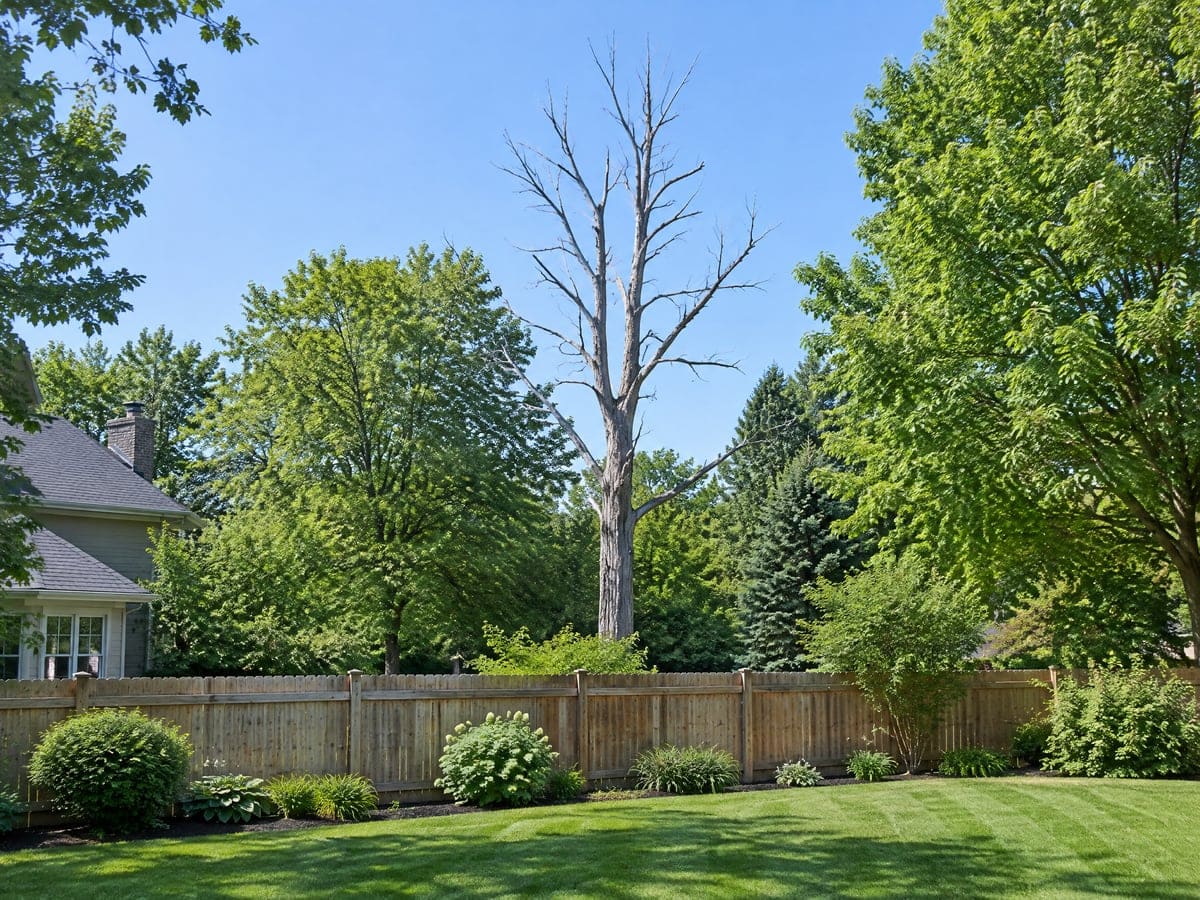
Is the tree dead, or just having a bad year?
Species and the pattern of dieback usually tell the two apart. A green crown with scattered bare twigs is one picture; a thin crown with the top third gone is another.
Spring leaf-out and dieback from the top
A tree that leafed out partway and stopped is in trouble, as is a tree where the top third stayed bare in June. Ash hit by emerald ash borer typically shows dieback starting at the top, with infested trees dying within two to four years and healthy ash of any size at risk.1
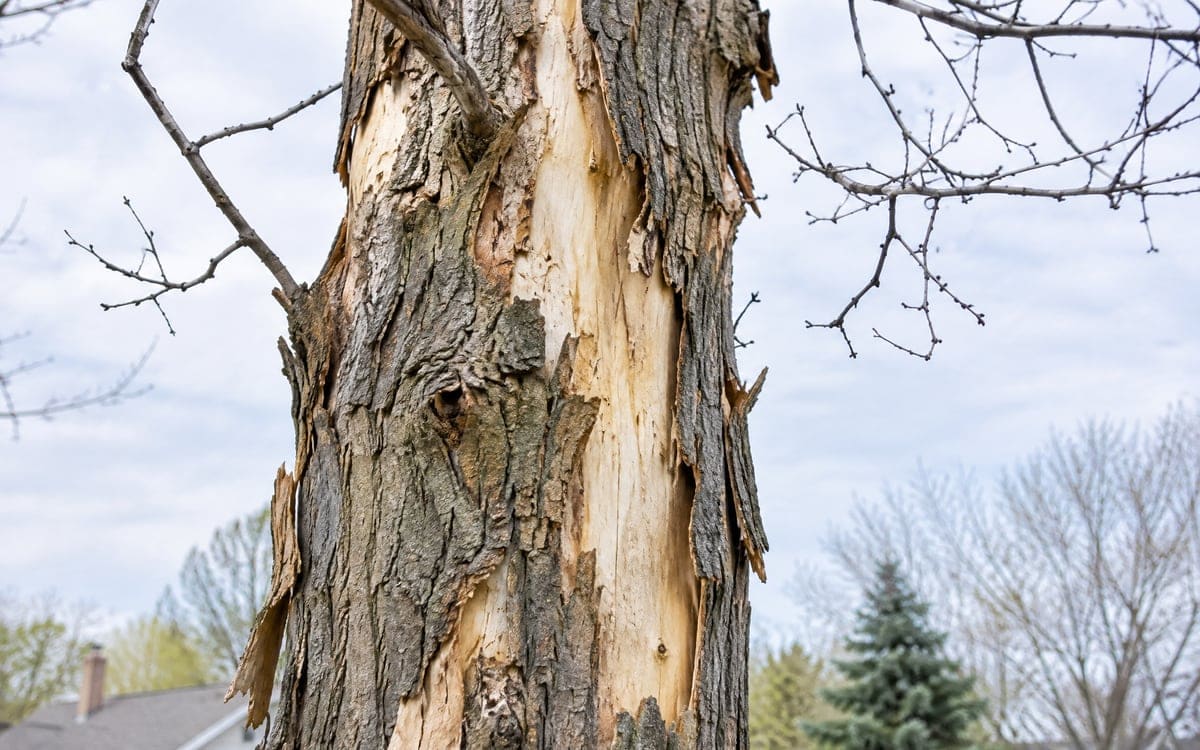
Bark, holes and woodpecker damage
Loose bark that peels off in sheets, bare wood under it, and sap seams that stay wet all point one way. Fresh woodpecker damage on an ash often means the birds are after beetle larvae under the bark; the holes themselves are the second clue, not the first.
The species: ash, the red oak group, American elm, silver maple
A red oak that goes brown through the crown in midsummer is a wilt check. Oak wilt turns up in all Illinois counties, and trees in the red oak group (red, black, pin, scarlet) usually die within weeks or months of infection, while white and bur oaks decline more slowly.2 On an ash with the top gone or no live crown, the Morton Arboretum's emerald ash borer page1 describes the dieback that follows the beetles.
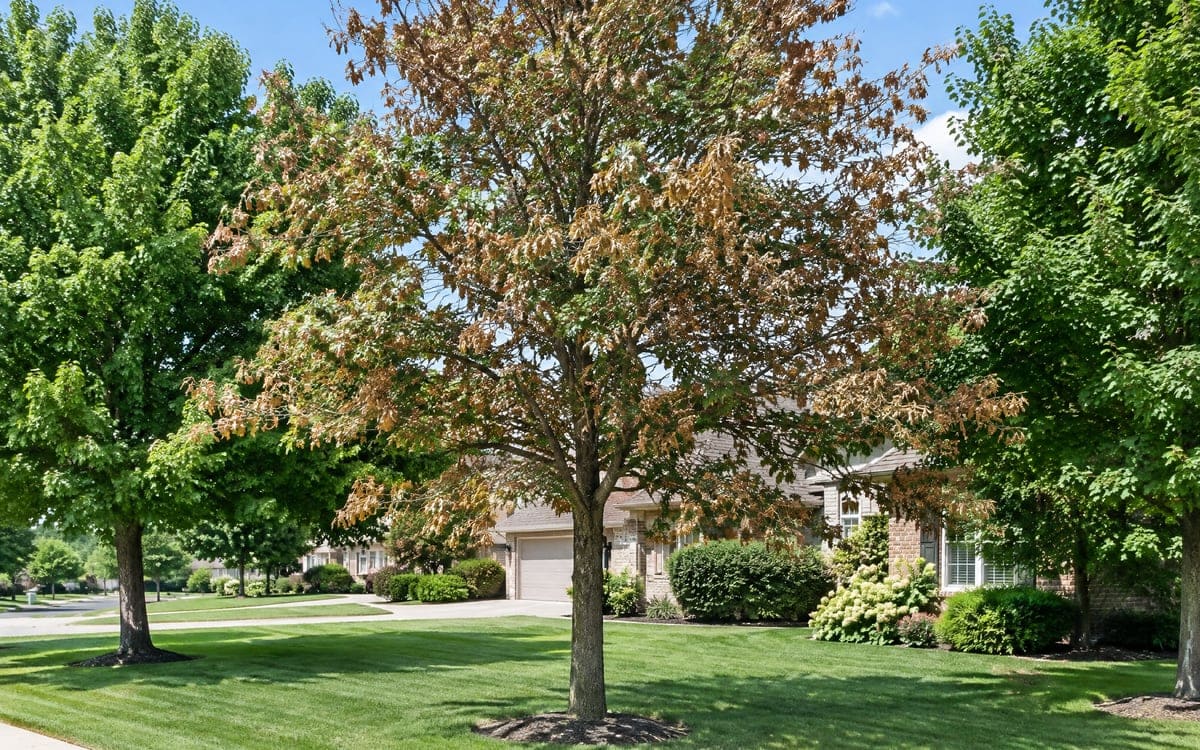
An American elm that wilts fast through the crown is a Dutch elm disease check; American elm is extremely susceptible, while Siberian elm is highly resistant.3 A silver maple with a dead side and a cracking fork is a different story and sometimes a cabling candidate before it is a removal.
Emerald ash borer, oak wilt, Dutch elm disease
Infested ash may die within two to four years; red oak group usually within weeks or months. Dutch elm disease spreads through bark beetles and root grafts.
Ash
- Emerald ash borer attacks healthy ash of any size; infested trees may die within two to four years, with dieback usually starting at the top.
Red oak group
- Oak wilt is in all Illinois counties; red, black, pin and scarlet oak usually die within weeks or months, while white and bur oaks decline more slowly.
American elm
- American elm is extremely susceptible to Dutch elm disease; Siberian elm is highly resistant. It spreads through elm bark beetles and root grafts.
Sources: The Morton Arboretum, Emerald ash borer; The Morton Arboretum, Oak Wilt; The Morton Arboretum, Dutch elm disease.
Why dead wood is harder to take down
Dead wood is brittle, so a limb that would bend when green snaps instead. A dead crown drops pieces without warning.
Trees of the same kind nearby
Oak wilt and Dutch elm disease move to the trees next door. Most new oak wilt infections spread through root grafts between oaks growing within about 50 feet of each other, and dead or infected red oaks should be removed before they form fungal spore mats.2 On a crowded parkway of elms, Dutch elm disease moves the same way. A removal is often also a look at the trees next to it.
| Symptom | Likely cause | What it usually needs |
|---|---|---|
| An ash bare at the top | Emerald ash borer, late stage | A removal from the top down |
| An oak brown through the crown in July | Oak wilt in a red oak | Removal, and a plan for nearby oaks |
| An elm wilting fast through the crown | Dutch elm disease | Removal, and attention to the elms next door |
| Bark falling away in sheets | A dead ash or elm | Removal before the wood turns brittle |
| A dead tree leaning | Root loss or trunk decay | Removal |
| A tree that did not leaf out at all | A dead tree | Removal, with no second opinion needed |
Keep it on standby, or take it down now?
When the tree is going to come down
- Any tree that did not leaf out this spring
- An ash with no live crown or with the top gone
- A red oak with wilt
- An elm with Dutch elm disease
- A standing dead tree over anything we would mind having a limb fall on
When it is worth another look first
- An ash still carrying most of its canopy
- An oak with scattered dead limbs and a green crown
- A tree a backhoe passed close to a year ago
- A tree with cosmetic damage and healthy new growth
A tree that may be sick is often an assessment before it is anything else. If the look says the tree has to go, the next call is scheduling the removal.
How a dead tree removal goes
On the call, say what the tree is, roughly how tall, how far gone, what stands under it and whether a line is nearby. The dead wood gets read from the ground before any work. The stump is agreed as part of the job.
Dead and dying trees in Hoffman Estates
Hoffman Estates has already been through one big round of dead-tree work. More than 6,000 ash trees have come out after emerald ash borer, and the ash left in the village are the ones residents and homeowners associations have treated.4 Emerald ash borer was first confirmed in Illinois on June 9, 2006.5 Twenty years on, the Illinois quarantine has been dropped,6 and the federal rule came off on January 14, 2021.7 The state still asks people to source and use firewood locally.
Parkway work continues. The Village is removing and replacing silver maple and Siberian elm parkway trees: about 2,400 trees were inspected in 2025 and about 425 were marked for removal in 2026, with at least two weeks' notice before a nearby parkway tree comes down.8 That is the Village's own work; trees on private property are the homeowner's, and the Village points residents to a private contractor.4 A private silver maple shedding limbs is the homeowner's to deal with.
For a dead tree that was never a disease case, the Village code approves a tree removal permit for a tree that is a safety hazard to traffic or structures, that is diseased or weakened by age, storm, fire or other injury, or that must come out for good forestry practice; each removed tree must be replaced with a similar species in a similar location.9 Whether a given lot needs a permit at all is a separate question; the Village tree rules page covers the permit side and the parkway rules together.