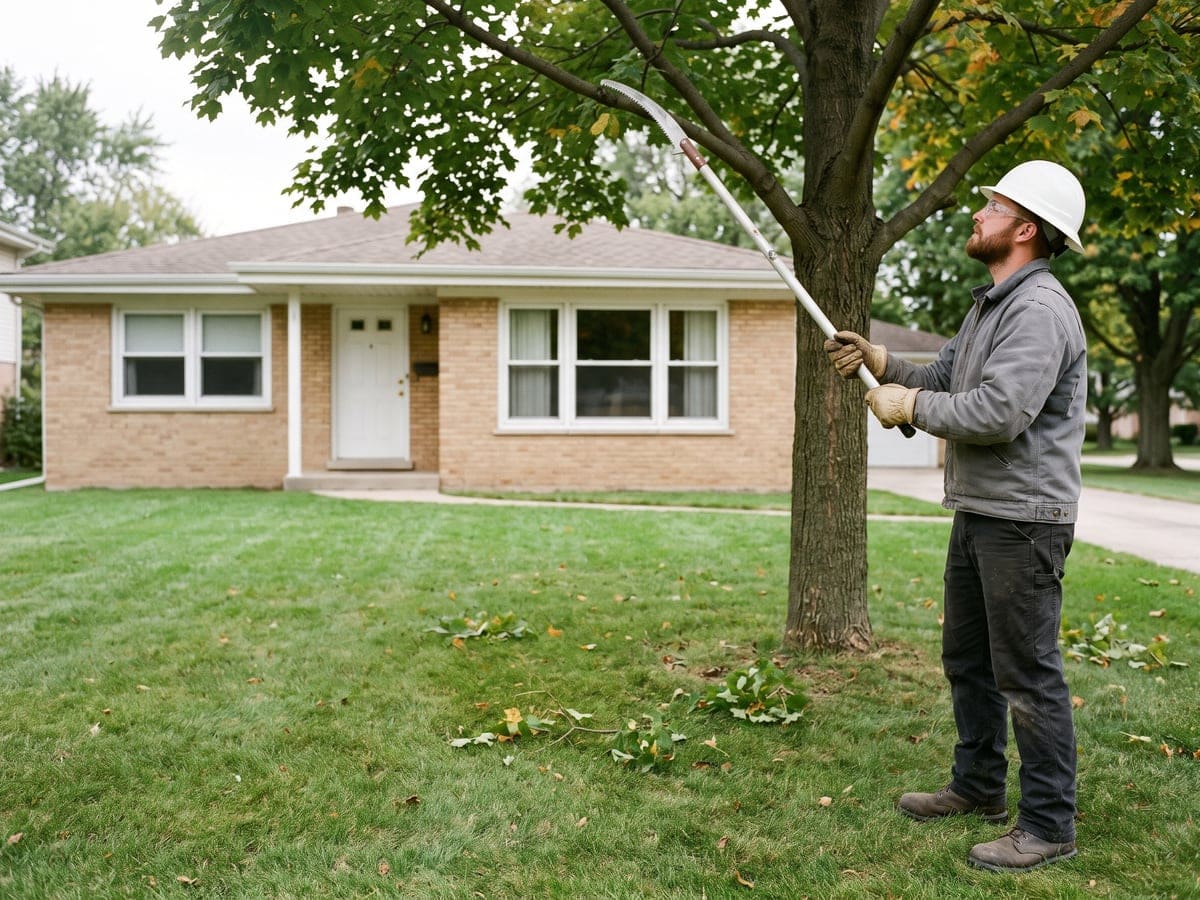
Private trees in Arlington Heights
The Village code2 says any tree, limb, or shrub overhanging a sidewalk or roadway in a way that impedes traffic must be trimmed by the owner of the abutting premises.
The zoning code on tree preservation
Arlington Heights' zoning code3 sets tree preservation requirements for public and private new construction, enlargements and other construction. The code excludes existing developed or contiguous single-family subdivided residential lots and public rights-of-way, unless a single-family lot has the potential to redevelop into three or more lots.
The three-inch rule applies to unimproved or partially improved land: no tree with a diameter of 3 inches or more, measured 6 inches above grade, may be removed from such parcels before the Planning Department approves a Tree Survey and Preservation Plan. Where a development plan is not required but a landowner wants to clear a site, a Tree Survey is still required and quality trees must be preserved.
Parkway trees in Arlington Heights
The Village's Public Works Department4 manages approximately 36,000 parkway trees along Arlington Heights streets. It is unlawful under the Village code to damage or remove any tree or shrub in a public street or parkway without a permit from the Department of Public Works; anyone who does so is liable for the replacement value of the tree, plus removal and parkway repair costs.
A contractor trims the Village's parkway trees on a 4-to-5-year cycle, removing dead branches, clearing branches below 14 feet on mature trees, and addressing branches within 8 feet of a structure where possible. For broken or hanging branches, sight obstructions, or low branches, residents can submit a Service Request to Public Works.4 Residents may request a parkway tree inspection from the Forestry Unit, which decides whether the tree requires removal or another solution; the Village uses removal as a tool only if necessary.
Forestry work in 2024
The Village's 2024 annual report5 says a Village-wide dead tree survey identified 557 parkway trees requiring removal in the next year, with Village crews planning to remove 364 of them. More than 17 percent of those trees were diseased ash trees that had finally succumbed to the emerald ash borer, and 22 percent were declining Norway maples, a species the report calls susceptible to root issues such as girdling roots and surface compaction due to utility work.
At least 81 of the trees are adjacent to overhead utility lines, along busy roads, or have other complicating factors; those go to the Village's tree removal contractor.
Stumps, restoration and replacement
After a parkway tree comes down, Village crews return later to grind the stump 8 to 12 inches below the surface. Underground utilities are located and marked before any grinding. Once the stump is ground, the parkway receives topsoil and grass seed when weather permits, spring through fall; the Forestry FAQ1 says the homeowner is responsible for watering the restored area. Replacement trees go in one-for-one where space allows, at no cost to the homeowner. The space requirement is 40 feet between trees; if the gap is smaller or utilities are in the way, a tree is not replaced.
Elm, ash and insects under the code
The Village code2 declares elm trees infected with Dutch elm disease and ash trees infested with emerald ash borer public nuisances, as determined by Village forestry staff or laboratory analysis. Keeping such a tree is unlawful, and the Director of Public Works may enter private property at reasonable hours to inspect elm or ash trees.
The code also declares gypsy moth and eastern tent caterpillar nuisances. After written notice from the Village, the property owner has 30 days to remove and destroy the insect nuisances; if the owner fails to act, the Director of Public Works may have it done.
Storm damage in Arlington Heights
Of the 27 NOAA Storm Events6 wind entries for Arlington Heights from 1996 through 2026, 23 name trees, limbs or branches.
A severe thunderstorm on August 27, 2024, struck the north end of the Village, and the 2024 report5 records numerous calls about entire trees down, with most of the damage along northern Arlington Heights Road north of Rand Road. That storm generated more than 200 storm related tree requests; 11 parkway trees were removed from that event. On October 31, 2024, sustained high winds brought multiple instances of tree damage in Arlington Heights. Forestry crews worked with IDOT and the Arlington Heights Police Department to remove a large private spruce that was uprooting and about to fall onto North Arlington Heights Road. A July 27, 2026, report for a location 2 miles north of the Village describes multiple trees and large limbs blown down along with power lines.
Companies with poles or wires in streets or alleys2 must, so far as possible and in the absence of a franchise agreement provision, keep those wires away from trees and keep the trees properly trimmed.
Any tree or limb resting against a power line after a storm: treat the wire as live, stay back, and keep everyone away. Do not approach a downed line or try to move anything off it. A line on the ground,7 sparking, or on fire is a 911 call, as is any injury on the scene. Report a limb making contact with a ComEd line8 to ComEd at 1-800-334-7661.
Landscape waste
Arlington Heights' 2026 landscape waste season9 runs from March 30 through December 18, collected by Groot using stickers or a subscription. Holiday trees go out January 4 through January 15, 2027.
Arlington Heights housing
Arlington Heights' median year built is 1974,10 per the Census Bureau's American Community Survey; the 1970s account for about 7,486 of the Village's 33,005 units, the 1960s for about 7,164, and about 1,617 predate 1940. About 17,642 units, roughly 53 percent of the total, are detached single-family homes,11 and about 11,414 are in buildings with five or more units; owner-occupancy runs around 74 percent.
Contractor registration in Arlington Heights
Arlington Heights contractor registrations12 are handled online through the Village's Civic Access portal and expire December 31 of each year. The contractor registration page does not name tree work.