Whoever digs has to call JULIE
Stump work and any other digging has one legal piece before anything else: a JULIE request. Illinois law requires anyone planning outdoor digging, whatever its depth or size, to notify JULIE at least 3 days before digging,1 even for planting trees and shrubs. The request is free.
The person doing the digging1 is the one who makes the call. A tree service that will grind the stump is the one who ought to be filing the JULIE ticket, rather than the homeowner. Ask the question plainly: do you call JULIE before any stump grinding?
A crew near the wires needs line clearance qualification
Not every tree crew is set up to work near a power line. For trees near the lines between poles on a property, ComEd gives homeowners three ways in:2 the utility's own clearance crew opens space along the wires so a private crew can finish the pruning, a no-charge investigation looks at whether a given stretch can be powered down for the work, or a private contractor whose trimmers meet the ANSI Z133.1 standard handles the whole job, with the owner carrying the cost.
That ANSI Z133.1 qualification is the standard that lets a private crew work close to a conductor. Ask any contractor whether their trimmers are line clearance qualified under Z133.1, and what their plan is for a tree near a wire. ComEd also warns homeowners not to climb or trim trees near power lines without precautions, and notes that even brief contact with a line, or a branch touching one, can severely injure or kill.2
Good pruning follows a published standard
Pruning that keeps a tree healthy follows a method that someone can check. ComEd trims trees and vegetation along its lines on regular four-year cycles, and its contractors prune to the ANSI A300 standard using directional pruning that steers growth away from the wires.3 The A300 standard is a general one for the trade.
Ask what pruning standard the crew works to, and listen for a plain, specific answer. "We follow ANSI A300" is a different answer from "we just know what to cut". The second may still be true for a careful crew, but the first is a thing you can look up.
An offer to top your tree tells you something
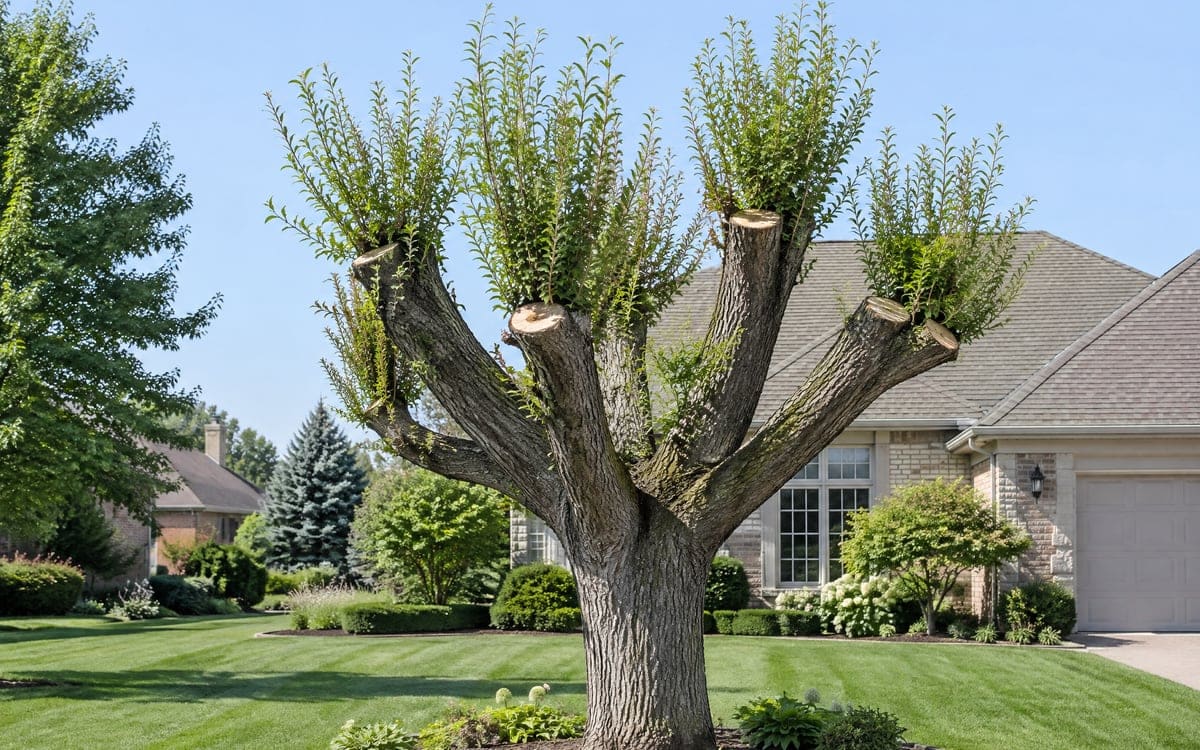
Topping a tree (cutting off the main leaders at a height to shorten the whole crown) weakens the tree and leaves it worse off than before. ComEd's maintenance page calls topping or rounding over a tree incorrect,3 because it causes a flush of fast-growing sprouts that grow straight back into the wires.
The same thing happens on a non-utility tree in a backyard. Topping produces thickets of upright sprouts, weakens the attachments at every cut, and ruins the natural form. A contractor who offers to top your trees is telling you how they work. Say no, and ask for proper crown reduction or pruning on the right calendar.
The parkway side is the Village's
A good crew knows which trees are not their job. The Village's own tree care guidance says residents should not trim parkway trees themselves4 and should call Public Works about broken, hanging or storm-damaged branches, and the code says no one other than Public Works or a Village contractor may remove a street tree without a permit from the Director of Public Works.5
A contractor who offers to trim or take down the parkway tree in front of your house without routing it through the Village has the wrong plan. The right answer on a parkway tree is a call to Public Works, rather than a saw by a private crew.
A credential is worth checking with whoever issued it
Whatever credential a contractor claims, check it with the organization that issued it. A credential's whole value is in that outside check, since anybody can print a logo on a shirt or a magnet.
The same applies to proof of insurance. Ask any tree service for a certificate of insurance showing both general liability and workers' compensation, and call the number on the certificate (not the contractor) to confirm the policy is active. That extra ten minutes catches a certificate that lapsed last year or was issued for a different company.
The wood, the chips and the stump on the quote
A clear quote says who takes the pile. Will the wood be hauled away? Left in rounds for firewood? Chipped on site and raked into a bed? Is the stump staying in the ground, grinding separately, or part of the quote? What about surface roots?
If those answers are missing, the price is incomplete. A good quote spells each line out. The quote price guide covers the drivers behind the number, and it is a useful second read before signing a quote with blanks in it.
Ask how the tree comes down near the house
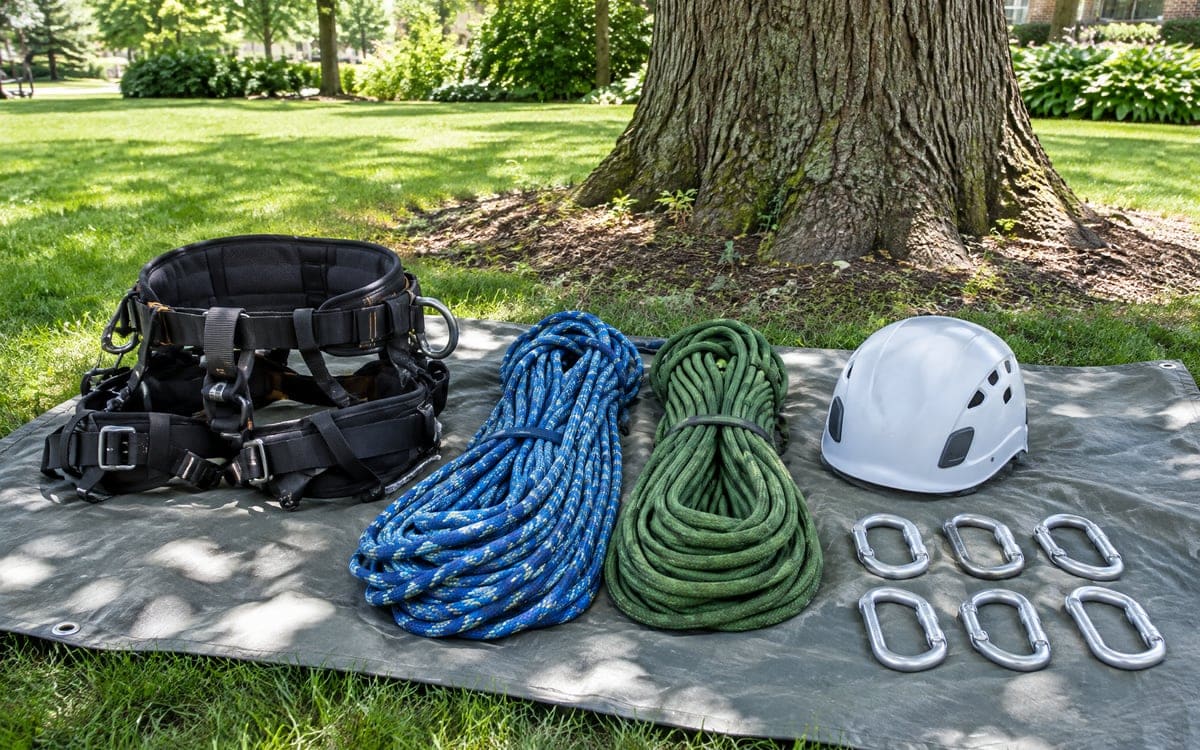
For a tree near a structure, the plan matters as much as the price. Will the crew climb the tree and lower pieces on a rope? Will a bucket truck reach it from the driveway? Does a crane fit the yard? Is there a plan if a tie-off point gives?
A crew who can walk through those steps on the phone or in the yard is thinking about the work ahead of the invoice. For a tree down near the house, that plan is what keeps the project from becoming a different project halfway through.
Ask about the oak calendar
If any of the trees to be worked are oaks, the Morton Arboretum's calendar matters. Oaks should not be pruned between mid-April and mid-October,6 when fresh wounds attract the beetles that carry oak wilt spores; the safest time to prune oaks is early November to very early April.
A crew that answers "when do we come out" with "whenever you want, we can do it tomorrow" is not treating the oak calendar as a real rule. A crew that asks whether the tree is an oak, and talks about dead or broken limbs as a different case, is paying attention. The exception is a dead, broken or hanging oak limb that is a hazard; routine oak deadwood waits for the window.
What the plan should name before work starts
A written scope before any deposit is the point here. The plan should name the trees worked, whether the job is pruning or removal, what happens to the wood and the chips, whether the stump is ground or left, any JULIE call that is needed, and any ComEd step that has to happen first (for a service wire drop, say).
Questions to ask any tree service
| Question to ask | What to listen for | Why it matters |
|---|---|---|
| Who calls JULIE before stump grinding? | The company doing the grinding takes it on, since state law puts the request on the person digging | Avoids a hit on a buried line, with the right party on the ticket |
| Are your trimmers line clearance qualified under ANSI Z133.1 for work near wires? | A clear yes under one of ComEd's three routes, with the line side handled first | Match the ComEd route to the crew doing the work |
| What pruning standard do you follow? | A specific standard a homeowner can look up, like ANSI A300, with cuts at the branch collar | A method with a name that can be checked |
| Will you top my tree? | A clear no, and a different plan such as crown reduction or removal | Topping is called out as incorrect practice |
| Who handles the parkway tree out front? | The Village, or a Village contractor | Parkway trees belong to the Village, and the code limits who may remove one |
| What credentials or insurance do you carry, and how can I verify them? | An offer to produce a certificate, with the issuer or insurer's number to call | Verification at the source, where a credential has its value |
| What happens to the wood, chips and stump? | Each piece spelled out on the quote, with the choice left to the owner | The pile is a cost; it belongs on the quote |
| What is the plan for the tree near the house? | A step by step, with crane or lift noted where it applies | A clear plan avoids a changed job halfway through |
| When can an oak be pruned? | Early November to very early April, with a decision on hazard cuts in the window made on site | The Morton Arboretum's window |