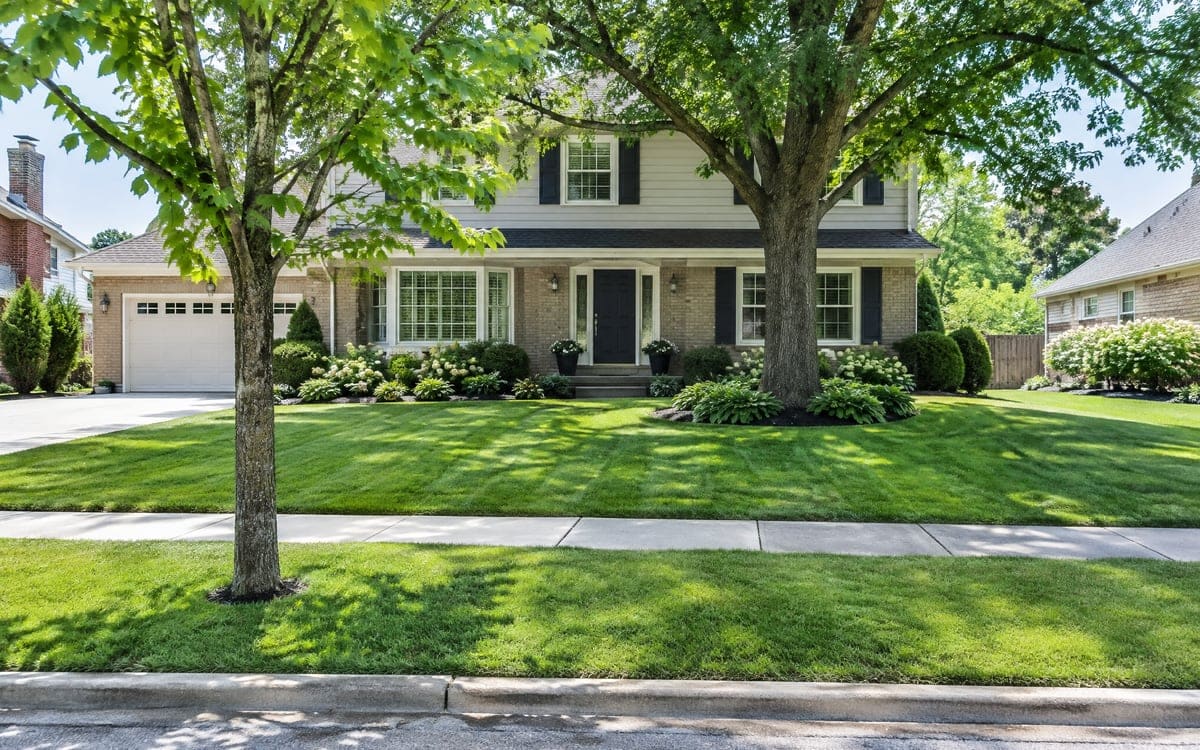
The tree between the sidewalk and the curb belongs to the Village
The grass strip that runs along the street, with a tree every so often, is the parkway. Parkway trees are owned and maintained by the Village,1 with routine trimming every four to seven years, mostly in late fall and winter. If you planted it or if it came with the house makes no difference. Once a tree stands in the parkway, it is on the Village's list.
That is also why its decisions on that tree are the Village's to make: the pruning schedule, the species chosen when a parkway tree is replaced, and the first call about whether a limb is a problem all sit with their Forestry team.
Residents are told to leave parkway trees alone
The Village's own tree care guidance says residents should not trim parkway trees themselves2 and should call Public Works about broken, hanging or storm-damaged branches. A ladder leaning against a parkway maple to clear a low limb is not a project the Village wants a resident to run.
For most parkway work, Public Works is the first call. Their Forestry Division inspects public trees for disease, decay and structural problems,3 with the Village's arborists deciding on treatment, trimming or removal, and residents can ask Public Works to look at a parkway tree they think is declining.
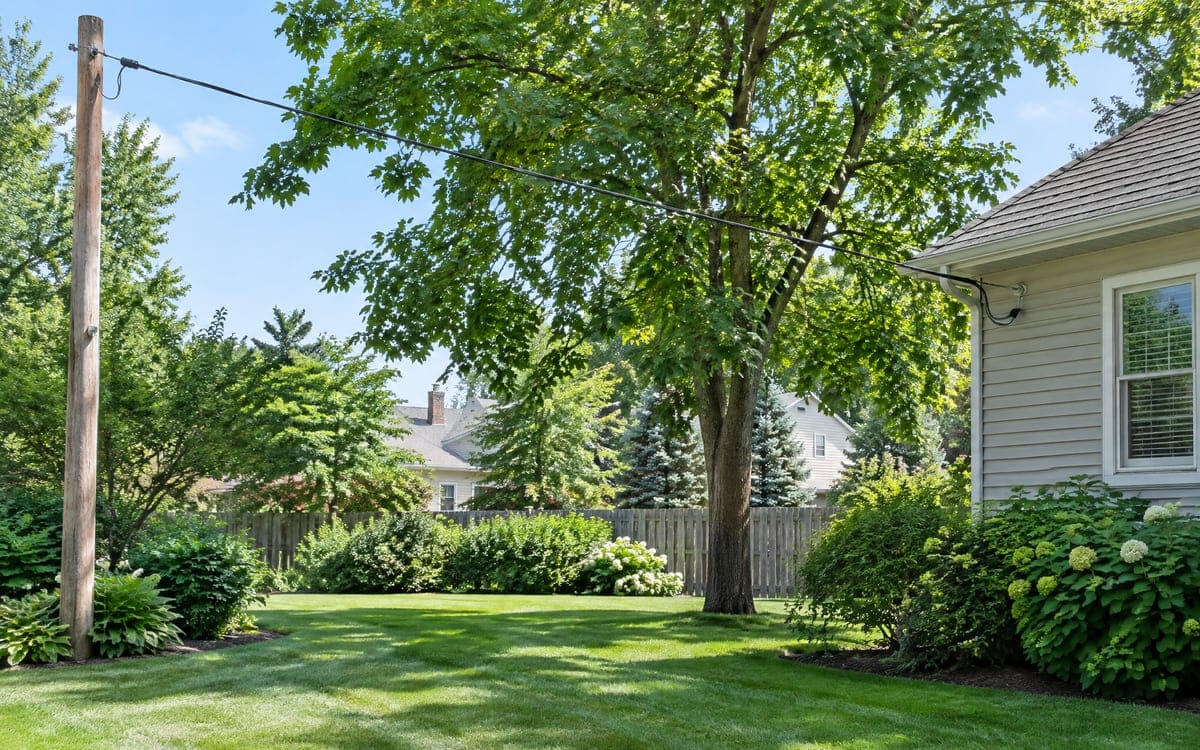
Everything on your side is yours to look after
The yard between the parkway and your fence is different ground. The Village maintains parkway trees only; trees on private property are the homeowner's responsibility,1 and the Village points residents to a private contractor for removal or trimming. The oak by the back deck, the maple over the garage, the ash in the side yard: these sit with you.
Parkway trees and private trees sit with different owners
Where the tree stands sets who looks after it and who to call about a problem.
Parkway trees
- Owned and maintained by the Village, with routine trimming every four to seven years, mostly in late fall and winter.
- Residents should not trim parkway trees themselves; call Public Works about broken, hanging or storm-damaged branches.
Trees on private property
- On the homeowner's responsibility; the Village points residents to a private contractor.
- Trimming, removal and storm cleanup on your side of the parkway sit with you.
Sources: Village of Hoffman Estates, Forestry (FAQ: How often will my parkway tree be trimmed?); Village of Hoffman Estates, Tree Care (Pruning and Maintenance).
That ownership covers the good parts and the hard ones. You decide when to prune, whether a split fork gets cabled, and whether the tree comes down at all. Removing a tree that is yours is your call. The code's 3-inch permit rule covers land other than developed detached single- or two-family lots under one acre and any removal in a right-of-way;4 for your lot, the Village's Development Services has the answer.
Sidewalk clearance falls to the homeowner too
Even when the tree in question is private, the public sidewalk is public. Homeowners must trim excessive landscape growth on their property near public sidewalks,3 and parkway tree branches blocking a sidewalk should be reported to Public Works.
Trim your private branches off the walk, and call Public Works for parkway ones. Trimming a private tree back from a sidewalk edge is a job we do.
Removing a parkway tree takes the Director of Public Works
Not every parkway tree stays forever. The Village code says no person, firm or corporation other than the Public Works Department or a Village contractor may remove a street tree without a permit from the Director of Public Works,4 and the request needs a written reason, approved driveway and building permits, and a Village review and site inspection. The permit holder pays for removing the tree and stump and restoring the parkway grade and turf, and a replacement charge applies by trunk size.
Those steps exist because a parkway tree is Village property. If a wider driveway or a new build makes a parkway tree a problem, the process begins with Public Works, not with a saw.
ComEd looks after its lines, with three routes for trees near them
Trees that grow into the power lines along the back of a lot have a third owner in the picture. For trees near the lines between poles on a property, ComEd lists three routes5 a homeowner can take: a visit from ComEd's own line clearance crew that opens space around the wires, a free investigation into whether those lines can be powered down for the work, or a qualified private contractor whose team meets the ANSI Z133.1 line clearance standard, with the owner picking up that bill.
ComEd lists three routes for a tree near a line
For trees near the lines between poles on a property, ComEd sets out three paths.
ComEd's line clearance trimmers
- ComEd's own trimmers clear around the lines, so a private contractor can do the rest of the tree.
A free line maintenance investigation
- ComEd looks at whether a given stretch of line can be de-energized for the work.
A private contractor
- A private contractor whose trimmers are line clearance qualified under ANSI Z133.1 does the work at the owner's cost.
Source: ComEd, Tree Trimming Assistance.
Which route fits depends on the tree, the line and what the homeowner wants done. The Village's forestry page refers residents to ComEd's Tree Trimming Assistance program3 for trees growing near power lines, utility boxes and poles.
The wire to your meter has its own arrangement
The low wire that runs from a pole or a transformer to the meter on your house is different from the lines between poles. ComEd does not do non-emergency trimming around the service wire that runs to a customer's meter. If a homeowner or their contractor trims there, ComEd will drop or de-energize the wire at no charge5 and reconnect it afterward, scheduled through 1-800-334-7661. The drop lets a crew prune near the wire safely for the day of the work.
A limb on a line is ComEd's to report, never yours to move
Any branch that is already touching a power line is treated as live. ComEd tells homeowners5 not to climb or trim trees near those lines without precautions, says a qualified contractor is the safer path, and warns that even brief contact with a line, or a branch touching one, can severely injure or kill.
If a limb is lying on a wire or likely to fall on one, keep people, pets and cars clear. Call 911 first if anyone is hurt or if a line is down, sparking or burning. ComEd asks anyone who sees it not to touch it and to report it at 1-800-334-7661.6 Our crew does not touch a tree that touches a wire until the line side is handled.
Storm debris comes back to the owner
After a storm, ComEd cuts and removes trees and branches from its own equipment, but disposing of the branches, logs and other debris is the customer's responsibility;6 ComEd says it cannot help with debris removal. The brush left in the yard is not theirs to haul.
That is part of why a quote for storm cleanup matters. If the tree is yours, the pile is yours too, and what the Village and ComEd leave on the ground is the piece a tree crew carries off.
A neighbor's tree is worth a conversation first
This guide is not legal advice. The practical place to start when a neighbor's branches hang over your yard is a conversation, often with photos. If you want a sense of what the tree is doing before that talk, a look at a tree you share a line with is a quieter way to come to it than a letter.
Where a tree is clearly dying and the branches already drop into your yard, bringing that to your neighbor as a shared problem usually goes further than framing it as a complaint. For a question about Illinois law on overhanging branches, an attorney is the right call.
Who handles which tree in Hoffman Estates
| Tree or situation | Who handles it | Source |
|---|---|---|
| Routine trimming of a parkway tree | The Village, on a four- to seven-year cycle | Village Forestry1 |
| A hanging or storm-damaged parkway branch | Call Public Works | Village tree care page2 |
| A declining parkway tree | Ask Public Works for an inspection | Village forestry programs page3 |
| Removing a street tree | Only Public Works, a Village contractor, or by permit from the Director of Public Works | Hoffman Estates Code 10-4-84 |
| A private tree in the yard | The homeowner, through a private contractor | Village Forestry1 |
| Branches over a sidewalk | Trim private ones; report parkway ones to Public Works | Village forestry programs page3 |
| A tree near lines between poles | ComEd's line clearance routes | ComEd Tree Trimming Assistance5 |
| Trimming near the service wire to the meter | Homeowner's contractor, with ComEd dropping the wire | ComEd Tree Trimming Assistance5 |
| A limb on a power line | 911 first if anyone is hurt or a line is down, sparking or burning; otherwise report to ComEd at 1-800-334-7661 | ComEd storm page6 |
| Debris left after ComEd clears a line | The customer | ComEd storm page6 |