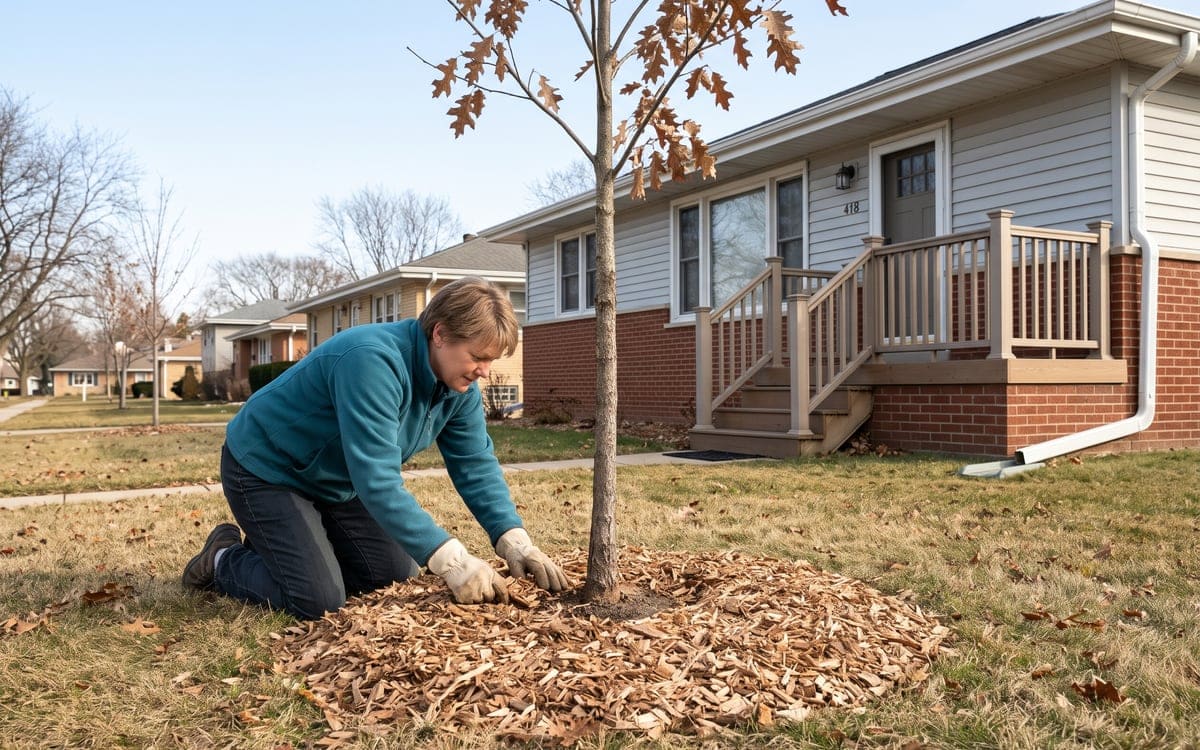
A flat ring, not a volcano
The common shape of mulch at the base of a tree is a steep cone, with chips piled up against the bark. That is the shape of a mulch volcano, and it is the shape to avoid. The Arboretum is direct: piling mulch up against the trunk, known as volcano mulching, creates ideal conditions for insect pests, diseases and decay.1
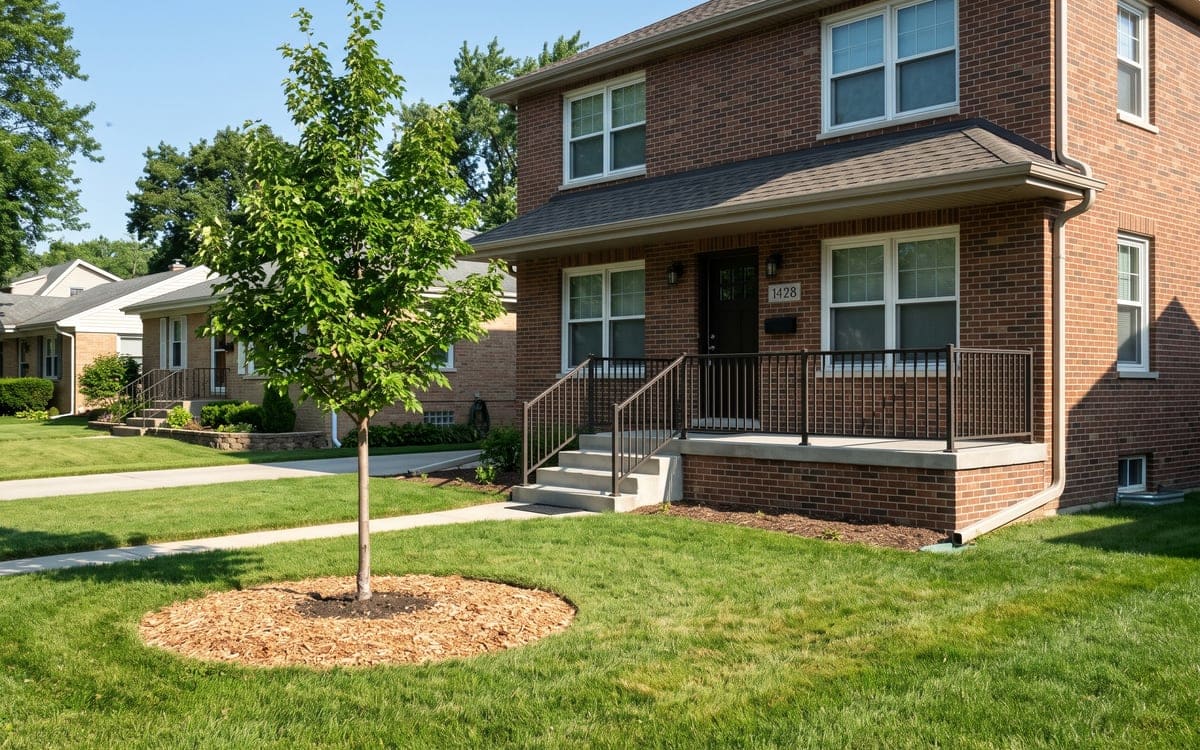
The right shape is a flat layer of chips forming a ring around the tree, with an open donut hole over the root flare. The chips hold moisture at the roots, mowers stay back from the trunk, and nothing wet rests against the bark. From the sidewalk the ring looks less dramatic than a volcano. It does far more for the tree.
Three to four inches of wood chip mulch does the work
Depth matters as much as shape. The Arboretum recommends 3 to 4 inches of medium- to coarse-textured mulch under trees, pulled away from the trunk to leave a donut hole.1 The Village's own guidance for parkway trees matches that: no deeper than 4 inches, in a saucer shape kept away from the trunk, because too much depth restricts oxygen to the roots and mulch piled against the trunk attracts pests.2
Three inches is enough to hold moisture through a dry stretch; four inches is the ceiling before the mulch starts smothering the roots underneath. A ring that got mounded up in last year's refresh usually needs the top layer raked off and spread wider rather than another load dumped on it.
The ring reaches out to the drip line
How wide the ring goes depends on the tree. The mulched area should reach the drip line on a younger tree and cover at least a four to five foot diameter circle around older, larger trees.1
On a young tree with a modest crown, the drip line is close in, and the ring is small. The ring grows with the tree, and each refresh is a chance to widen it toward the drip line. For a mature tree with a wide crown, matching the full drip line is often not practical in a residential yard; the four- to five-foot minimum covers the roots doing the most work.
Mulch around trees cools the soil and slows evaporation
Hardwood chips hold water better than bark chips and can be long-lasting.1 Water that soaks into bare soil also evaporates back out when the sun hits it. A three-inch chip layer breaks that direct contact, keeps the soil beneath cooler on a July afternoon, and lets rain soak in rather than run off. The watering done to keep a new tree alive goes much further when the chips are holding it in place; the guide on how often to water a new tree covers how the two steps fit together.
Fresh chips from a trimming or removal can stay on the yard
A trimming or removal job leaves chips. Those chips have more use on the yard they came from than most people realize: as mulch around other trees and shrubs, as a path through a back garden, or around a play area where soft ground is wanted.
Fresh chips are sometimes said to pull nitrogen from the soil, which is true at the thin interface where chips meet dirt and almost never a problem for trees drawing from below the chip layer. Spread on top of soil, chips do not harm established plantings. Whether the chips from a job stay on the yard or leave with the crew is your choice when we quote.
In Hoffman Estates, free wood chips come from the Village
For residents who want more chips than their own trees produce, the Village says free wood chips are available for pickup at the Public Works Fleet Maintenance Facility, 2405 Pembroke Ave., on weekdays after 3pm and anytime on weekends, with a call to Public Works before pickup to confirm availability.2
For a larger project, residents can also request free delivery of a half load (4 cubic yards) or a full load (8 cubic yards) of wood chips from Public Works. Deliveries are made as time permits and cannot be scheduled for a specific date or time.2 A full-yard mulch refresh, or chips for a new bed along a back fence, often cost nothing but the time to pick them up or the patience to wait for the delivery truck.
When a volcano is already in place
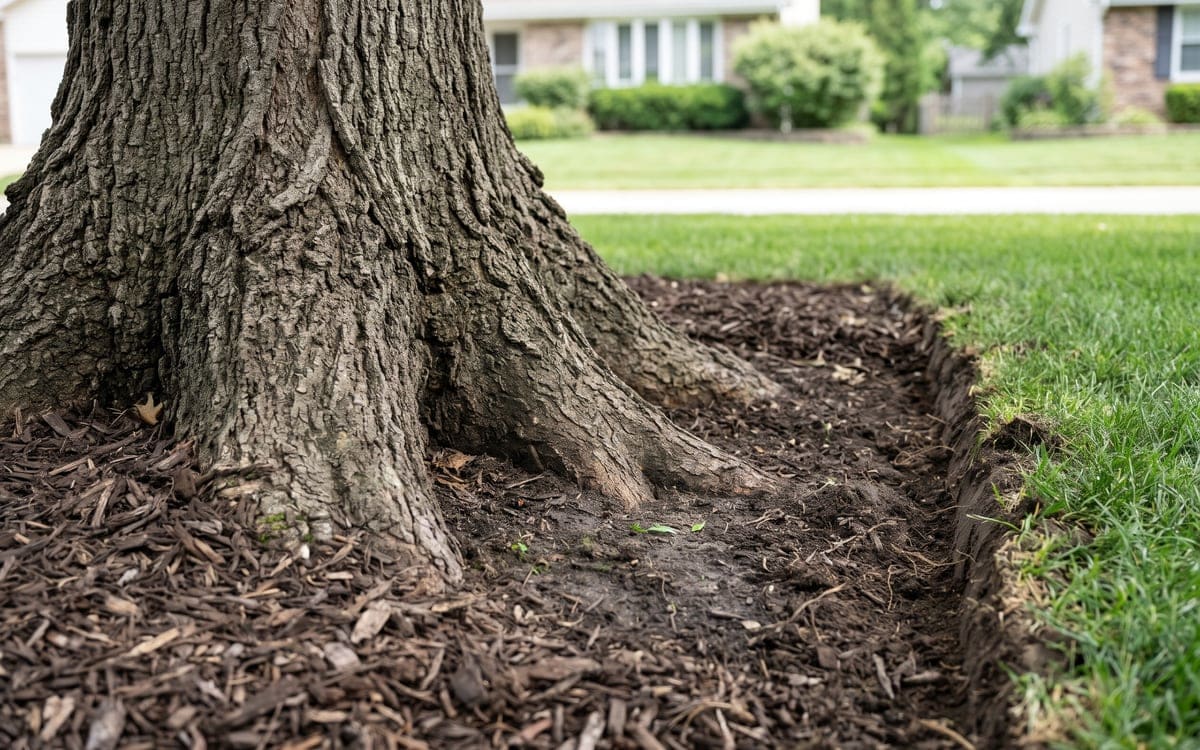
A mulched tree that no longer shows its root flare is a tree with a volcano on it, even if the pile came from annual top-ups rather than a single bad load. Chips held against the bark stay wet long after a rain, and the bark softens, splits, and lets rot and insect pests into the trunk at the root collar.
How to mulch around a tree correctly starts with pulling the chips back. If a trunk goes straight into the ground like a telephone pole, the mulch has buried the flare, and the root collar is the first place to check for decay. Rake the chips back by hand, uncover the flare, and if the bark underneath is soft or peeling, have a crew look at the tree.
Wait for the soil to cool before fall mulching
For fall mulching, wait until the soil starts to cool, which can be assumed once cooler air and frosts are occurring regularly, and one frost alone does not mean the soil has cooled.1 A single early-October frost is not the signal to spread fresh mulch. For a new tree going in during the fall planting window, the same timing holds when a chip ring is added after planting; the depth and the gap at the trunk stay the same.
Where wood chips do not belong
Chips do not belong on a vegetable bed, where they slow soil warming and compete at the interface, or in a planting hole as backfill, since the tree needs mineral soil against its root ball. Keep them off the siding of a house too, where they trap moisture against the sheathing, and off a parkway tree except in the saucer shape the Village describes.
A stump that has been ground out leaves a cone of chips in the ground. The chips come out of the planting pit if a new tree is going in the same spot, and the rest can be raked flat as mulch over the adjacent area. For a lot where several stumps come out at once, the lot clearing page covers the work.