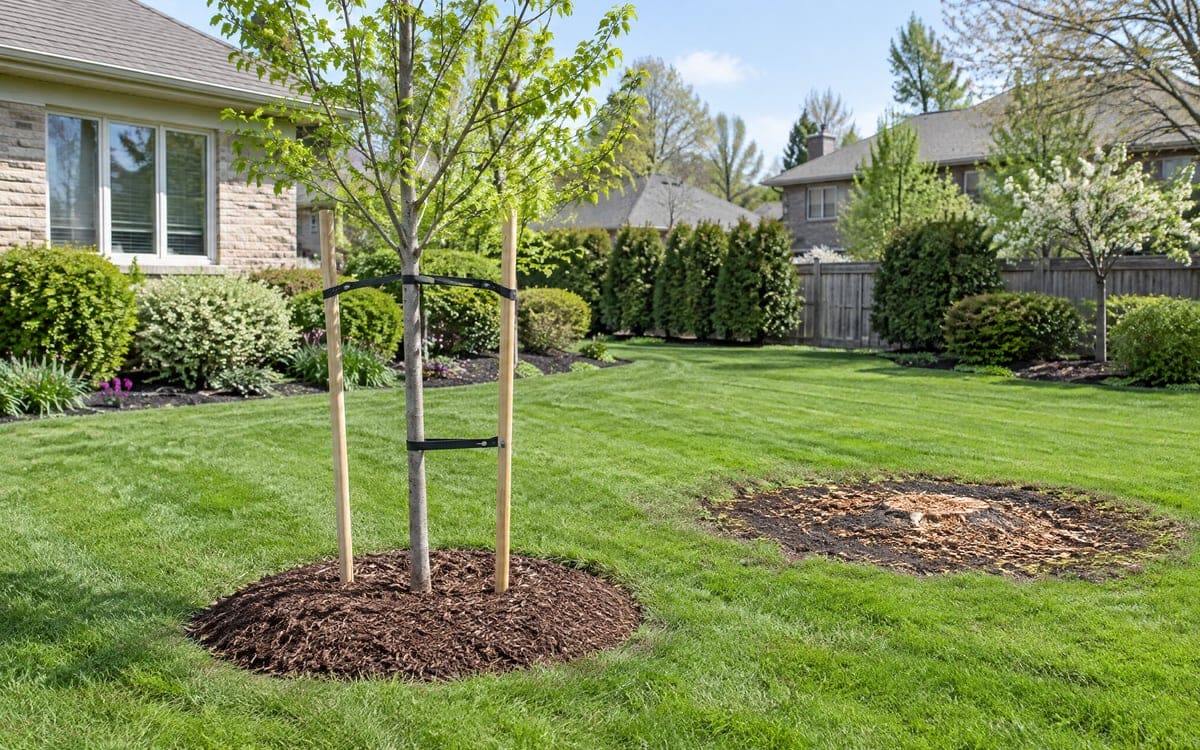
The old stump decides where the new tree can go
A new tree does not go into the hole where the old one came out. Root flares, dead wood below the soil line, and residual stump material get in the way of a fresh root system. Grinding the old stump opens the ground enough to work with, which is a start on the planting pit, not the whole job.
Even with the stump gone, planting a tree of the same species in the same spot is often not the right move. Soil-borne problems, root diseases and compaction from the old tree can carry over. The planting spot either shifts a few feet, or the species changes, or both.
Grinding chips are not planting soil
A ground stump leaves a cone of fresh wood chips. Chips are good mulch and poor soil. A new tree's root ball needs mineral soil in contact with it, not a bed of carbon that is still breaking down.
The practical fix is to pull the chips out of the planting pit, backfill with native soil, and keep the chips on top as mulch beyond the root ball. That takes a bit more work than scraping chips into the hole, and it gives the new tree a much better first year. A thin ring of chips around the trunk (not piled against the bark) finishes the mulch job without smothering the root flare, and the extra chips from a grind can mulch other beds in the yard rather than go to waste.
A JULIE request comes before the shovel
Illinois law treats planting a tree as outdoor digging, and the rule is the same as for any other dig. Illinois law requires anyone planning outdoor digging, whatever its depth or size, to notify JULIE at least 3 days before digging,1 even for planting trees and shrubs; the request is free and can be made by calling 811 or online.
That rule applies to a homeowner planting on their own, and it applies to a crew. The locator paints come first, the shovel comes next. Skipping the step because the tree is small is not a defense if a sprinkler main or a gas line is in the way.
Private lines are yours to find
JULIE's locators do not mark everything. Private lines such as sprinkler lines, private lighting and secondary electric lines to detached garages are not marked1 by JULIE's member utilities.
That means a planting plan has to think about those private lines too. The hose to the sprinkler zone in the back lawn, the low-voltage cable to the yard lights, the feeder to the garage are all on the owner. Where paint marks have been placed, the tolerance zone is 18 inches on either side of a marked line plus the line's width,2 with hand digging only inside it. The tolerance zone sits over every marked line in the yard, which is what makes the paint and the flags more than a suggestion.
ComEd spaces tall trees well away from its lines
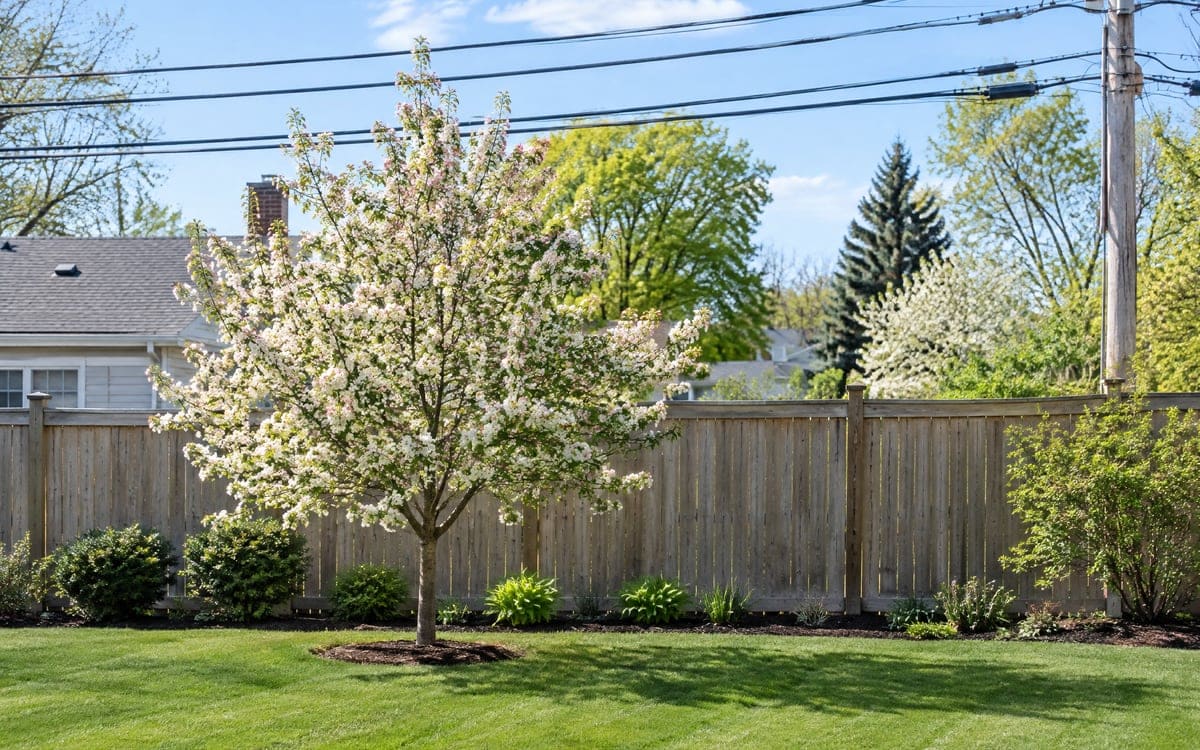
A pretty tree in the wrong spot grows into the lines. ComEd recommends that trees planted within 20 feet either side of pole-to-pole power lines have a mature height under 25 feet, and that tall-growing trees go 50 feet from the lines.3
That means a replacement under or near a line is a small ornamental tree, rather than an oak or a maple. A tall tree belongs well away from the wires, where its mature crown has room above it. Planting the wrong tree in the wrong spot gets a crew back on the same tree every few years to clear the lines.
The Village's street tree list is a good place to start
The code's list of large street trees in Hoffman Estates is a short course in species that work here. The list includes Freeman, sugar and Norway maples, hackberry, ginkgo, thornless honeylocust, Kentucky coffeetree, London plane, several oaks (white, swamp white, bur, red, chinkapin and others) and lindens,4 and trees under overhead lines must be sized so they do not interfere with the lines.
That list is for street trees. On a private lot it is still a useful reference. A replacement that matches the pattern on the street tends to settle in faster, and a mix of species on a block is more resilient than a street of the same tree planted the same year.
Parkway replacements are the Village's call
If the removed tree stood in the parkway, the planting decision is not yours. The Village has a program under way for silver maple and Siberian elm parkway trees: about 2,400 were inspected in 2025, and roughly 425 of those were marked for removal in 2026,5 with at least two weeks' notice before a nearby parkway tree comes down. The Village is removing and replacing those parkway trees.
The guide to parkway or private covers which side of the sidewalk the choice sits on.
Ash and American elm are poor bets for a new tree
Two common shade trees are not species to replant today. Emerald ash borer attacks healthy ash of any size, and infested trees may die within two to four years,6 with dieback usually starting in the top of the tree.
Elms are a related story. American elm is extremely susceptible to Dutch elm disease,7 while Siberian elm is highly resistant. Picking a species that is not fighting a known pest or a known disease saves the yard a tree planted into trouble.
An oak next to oaks carries a root graft risk
Replacing a lost red oak with another red oak in a yard full of oaks has one more wrinkle. Most new oak wilt infections spread through root grafts between oaks growing within about 50 feet of each other,8 and dead or infected red oaks should be removed before they form fungal spore mats.
Oaks still belong in the region, and they are on the Village's own list. The reason to think about which oak, rather than planting the first one you see, is to avoid dropping a susceptible red oak into a group that is already in trouble. A white oak or a bur oak in a yard full of red oaks is a different bet than another red oak in the same spot.
The village canopy grew from 2010 to 2017
The Chicago Region Trees Initiative's summary puts the village's tree canopy at 28 percent, up from 26 percent between 2010 and 2017,9 with the most canopy in natural areas and on residential properties. A new tree in a private yard is one of the moves that gets a figure like that to move; a tree lost to ash borer or Dutch elm disease is one of the moves that works against it.
Species notes from the Village's own large street tree list
The Village's list of large street trees4 names Freeman, sugar and Norway maples, hackberry, ginkgo, thornless honeylocust, Kentucky coffeetree, London plane, lindens, and oaks in the white, swamp white, bur, red and chinkapin group. A few of these need a note of their own:
| Species | Note |
|---|---|
| Red oaks | Mind the oak wilt root graft risk8 in a yard that lost a red oak to wilt |
| Small ornamentals under 25 feet | Within 20 feet of overhead lines, per ComEd's planting distances3 |
| Ash | Not recommended, with emerald ash borer in the region |
| American elm | Not recommended, with Dutch elm disease in the region |