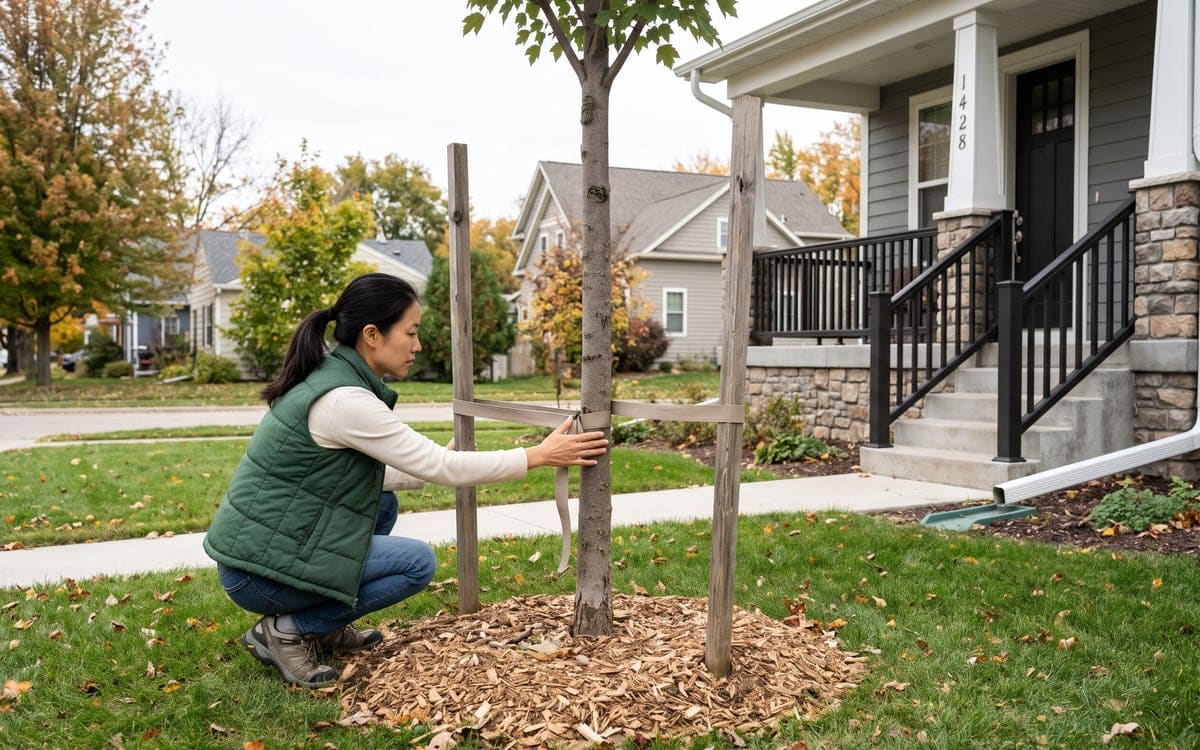
Most new trees in Hoffman Estates do not need a stake
Staked trees are so common in nursery lots that it is easy to assume every new tree should go into the ground with wood on both sides of it. The Arboretum's actual advice is narrower: new trees occasionally need support, especially on windy sites, but should not be staked too rigidly, since some trunk flexibility lets the flare at the base develop naturally.1
A tree planted into reasonable soil, on a yard without an open wind corridor, usually stands on its own from the first day. Habitual staking carries a cost. A trunk that never has to brace itself ends up with a thinner caliper and a weaker flare, and a stake left on too long saws into the bark.
The trunk needs to flex to build its flare
The flare is the widening at ground level, where the trunk meets the roots. On a mature tree it is the structural anchor that keeps the whole thing upright. It develops when the lower trunk moves a little in the wind as the tree grows.
A tree held rigid by stakes does not build that flare. The trunk ends up with a narrow base, which sometimes cannot hold the tree up once the stakes come off. A looser stake, taken off inside the Arboretum's window, protects the root ball without taking that natural flex away.
When a stake is actually worth putting in
A stake is worth the effort in three situations: a yard with regular hard winds across an open lot, a sandy or very loose soil that does not grip the root ball, and a tree whose top is heavier than its root ball below (common on container stock that spent a season leaning in the yard). Any one of these is enough for a short-term stake; a sheltered yard with firm soil and a well-grown root ball is a yard where the stakes stay in the shed.
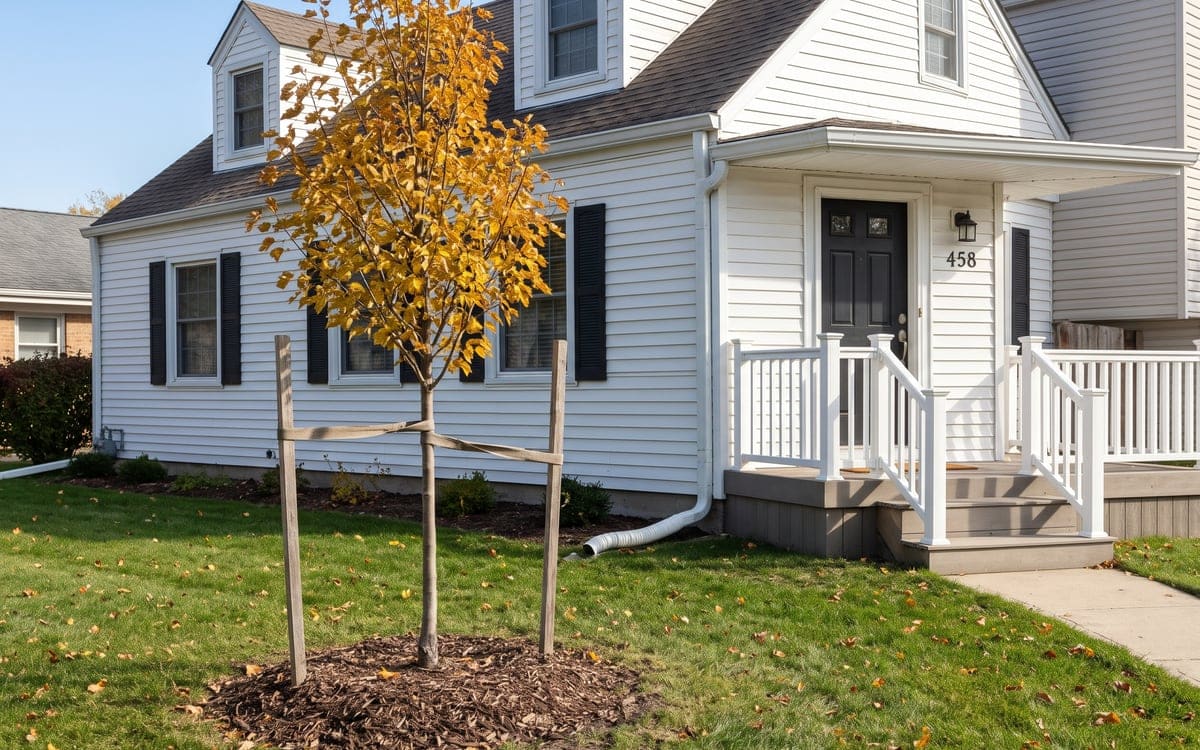
One stake for a small tree, two for a larger root ball
How to stake a tree starts with how many stakes and where they go. A small ornamental or a bare-root whip usually takes one stake, set at an angle into firm soil outside the planting hole, with a single tie low on the trunk, as low as still holds the tree upright. A larger container or balled-and-burlapped tree takes two stakes, set vertically on either side of the trunk, outside the root ball, with ties on opposing sides at the same low position.
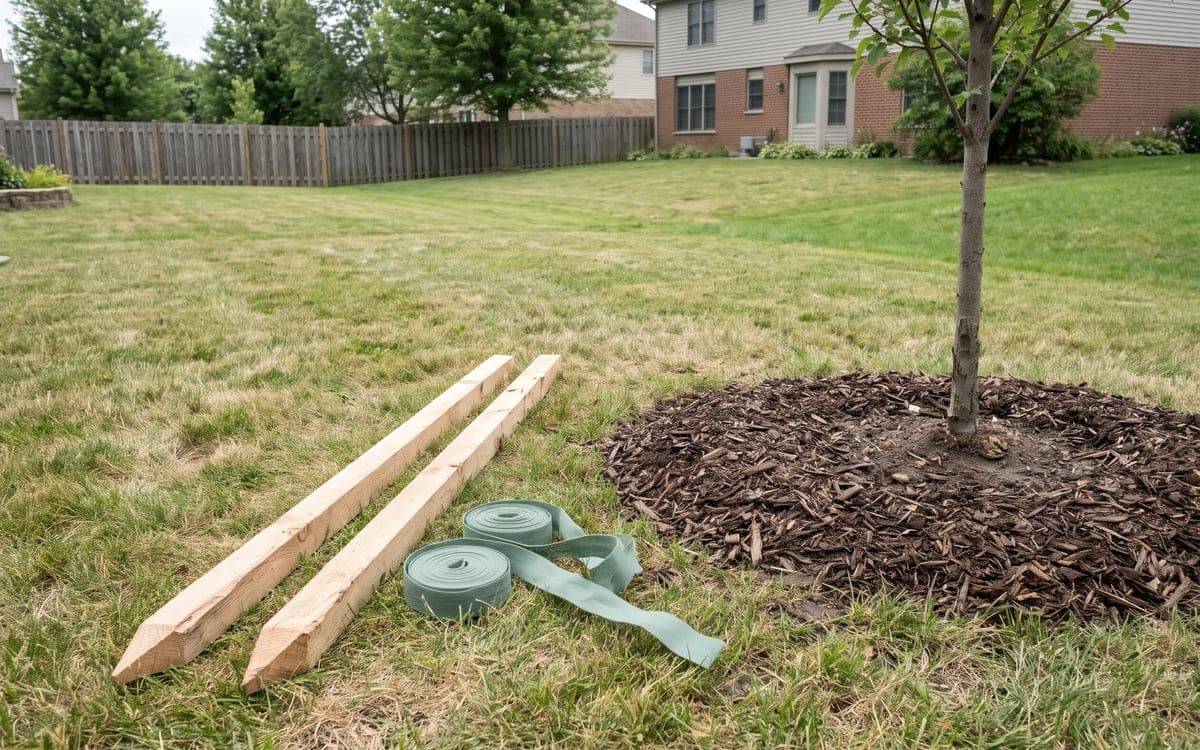
Driving stakes or metal T-posts into the ground is itself outdoor digging. Illinois law requires anyone planning outdoor digging, whatever its depth or size, to notify JULIE at least 3 days before digging;2 staking done on its own needs its own JULIE request from whoever drives the stakes. The fall planting guide covers how that request works. The stakes themselves can be any sound untreated wood or metal T-post, and they sit outside the root ball, never driven through it.
Soft, flat ties that stay loose
Tree stakes work only if the ties let the trunk move. Narrow wire or nylon rope cuts into the bark on every windy day. Flat tree-tie webbing or strips cut from an old inner tube spread the load across the trunk and ride against the bark without cutting.
Tie position stays low on the trunk, as low as still holds the tree upright, so the top is free to move. The loop around the trunk is loose enough that a flat hand slides between the tie and the bark. On every visit to the yard, feel the ties: a tie that was loose in October can be tight in July as the trunk thickens.
When to remove tree stakes
Stakes come off sooner than most people expect. The Arboretum says to inspect staking material regularly and remove it after one or two years.1
A gentle push on the trunk at knee height is the practical test: if the root ball stays put and the trunk flexes a little, the roots are holding and the stakes have done their job. If the root ball shifts, give the tree more time and check again before the second year is out.
Pruning after planting stays limited
Pruning and staking often get grouped together as new-tree chores. The Arboretum's advice on pruning right after planting is to limit it to removing dead, rubbing or broken branches, and to wait at least a year before removing larger limbs or shaping the tree.1
The reasoning is similar to staking: a tree that lost as much as 90 percent of its root system when it was removed from the nursery and needs about one year of recovery for every inch of diameter1 does not have the reserves for a big haircut. Fewer leaves means less photosynthesis means slower root growth. Deadwood and crossing branches can go now; shape waits. Our trimming page covers what a first real pruning looks like once the tree is ready, and the pruning calendar explains when oaks and other species belong on a saw.
Young parkway trees belong to the Village
Not every young tree in Hoffman Estates is a tree a homeowner stakes. Parkway trees, the ones between the sidewalk and the street, are owned and maintained by the Village, with routine trimming every four to seven years, mostly in late fall and winter.3 Residents should not trim parkway trees themselves and should call Public Works about broken, hanging or storm-damaged branches.4
The same rule covers staking. A homeowner noticing a problem with a young parkway tree should report the concern through the Forestry Division rather than add a stake. The guide to parkway or private covers which side of the sidewalk a given tree sits on. For a yard tree leaning past the sway a stake can fix, the next step is a short visit to look at it rather than another stake.