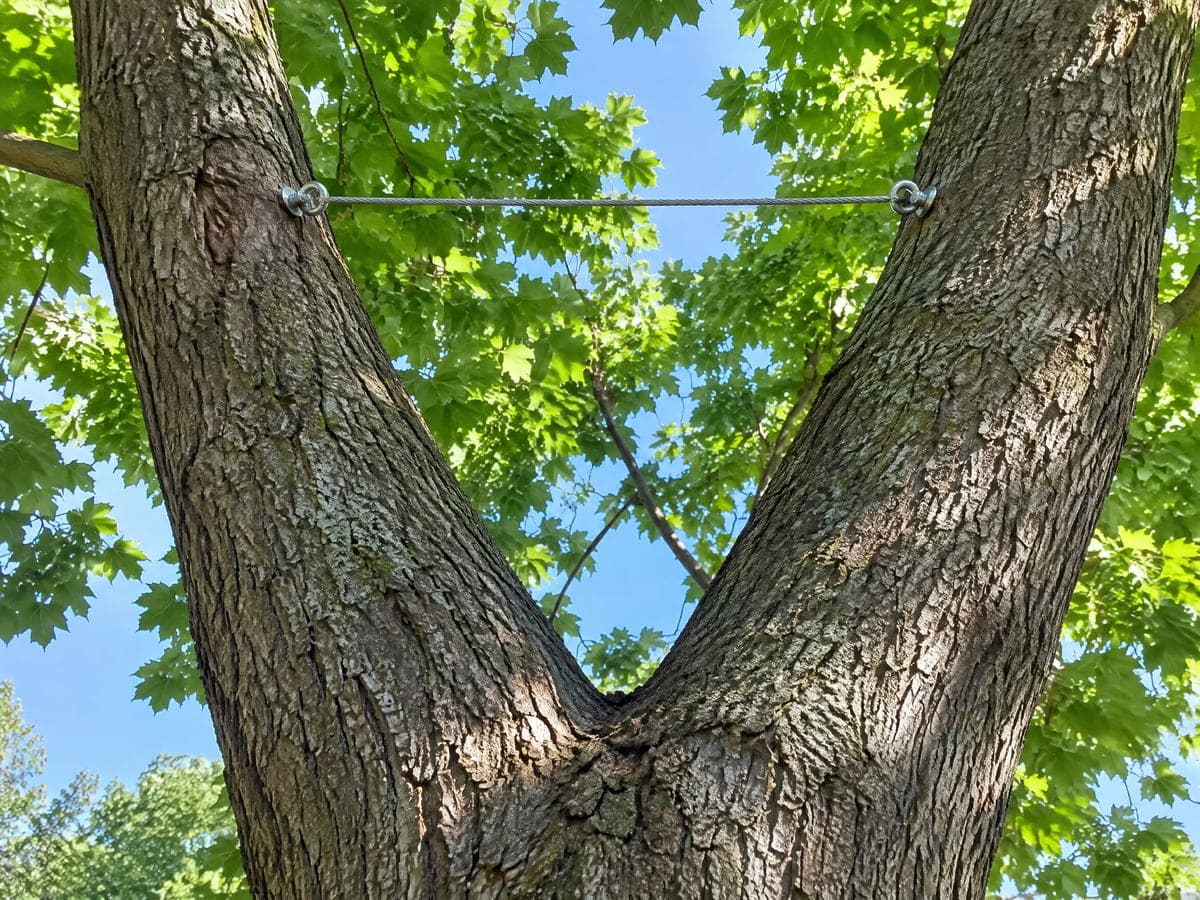
Can this split be held together?
The look that comes before any hardware is about the fork, the crack and what is behind it.
The fork: a tight V and pinched bark
Two stems that grew up tight against each other with bark pressed in between (included bark) make a weak union. A sound U-shaped fork can carry weight the same tree would drop from a V, and the difference shows at the join.
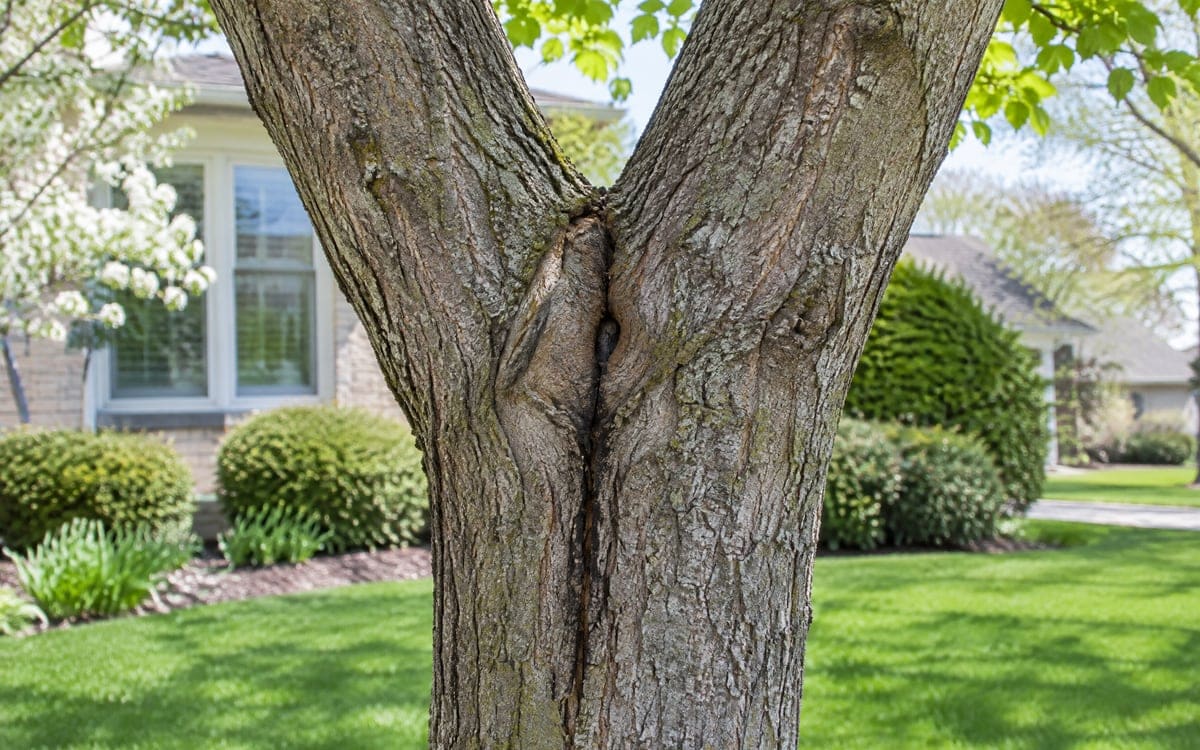
Any crack, and how far it runs
A short, old crack that healed over at the edges is one thing. A fresh crack with light-colored wood inside, running down from the union, is another. The length of the crack, and whether it reaches below the fork, usually settles whether cabling makes sense or the tree is a removal.
Decay in the trunk below the fork
A cable holds a top together; it does not hold up a hollow stem. A tap on the trunk below the fork reads change in sound, and the base can show shelf fungus or soft tissue. A fork with sound wood under it is a cable candidate; a fork over decay is not.
Weight in the limbs and what they hang over
Weight is the strain the hardware will carry, and it rarely gets lighter on its own. A long limb reaching out over the house, with no leader to balance it, is harder on the fork than two shorter stems over the lawn. Pruning for weight first can change the whole picture.
Whether pruning alone takes enough off
Sometimes a reduction cut is the right call. If taking a few feet off the end of each stem brings the strain back into the range the fork can carry, the tree gets a prune and no hardware at all.
| Symptom | Likely cause | What it usually needs |
|---|---|---|
| A tight V-shaped fork, no crack | Included bark, with the strain building | Pruning for weight, with a watch on the fork |
| A fork with a fresh crack | A split starting | A cable through the two stems, often with a brace rod |
| An old cabled tree with worn hardware | Years of growth around the old cable | A new cable, or a decision to retire the tree |
| A long limb heavy over the roof | Weight the fork cannot carry | Pruning first, cabling if the fork is sound |
| A trunk with decay below the fork | A fork a cable cannot save | A removal plan |
When cabling makes sense, when it does not
When cabling makes sense
- A tight V with light cracking and sound wood below
- A fork on a tree the yard wants to keep
- A long limb over something, where weight reduction and a cable together bring the strain down
- A tree that has already lived with a cable and is due for new hardware
When the split is too far gone
- A crack that reaches below the fork and down the trunk
- Decay in the stem under the fork
- A fork on a tree with other problems, like a sick crown or a leaning base
- A tree over a target where even a lower chance of failure is too high
The call at the yard is a slow look at the fork from several angles, a tap on the trunk below it, and a conversation about what the tree would land on. The decision stays with the homeowner; what cabling buys and what it does not get laid out plainly.
Two kinds of fork, with different strength
Sharp-angle unions are weaker than wide ones.
A sharp-angle union
- Branches that meet the trunk at sharp angles are weaker than wide ones.
A wide-angle union
- Branches that meet the trunk at wide angles are stronger than those at sharp ones.
Source: The Morton Arboretum, How to Care for Trees After Storms (Before the Storm tab).
A cabling visit from the call to the yard
On the call, describe the tree, the fork, any crack visible from the ground, and what stands under the limbs. The fork gets a look from more than one angle before any plan: a tap on the trunk, a read of the tree. The quote lays out what the work covers (pruning for weight, the hardware, the install) and what it does not.
Cabled hardware needs a check from time to time as the tree grows, since bark closes around steel over the years. There is no set interval.
Storms, forks and parkway rules in Hoffman Estates
The June 10, 2026 derecho downed a tree onto power lines 1 mile northwest of Hoffman Estates, with gusts up to 80 to 85 mph and widespread wind damage across much of northern Illinois.1 Heavy ice loads during ice storms can break limbs or ruin whole trees and bring down power lines.2 Each round adds strain to forks that were already carrying all they could.
Cabling is for private trees. The Village's tree care guidance says residents should not trim parkway trees themselves and should call Public Works about broken, hanging or storm-damaged branches;3 the hardware under a parkway tree's fork is the Village's call.