When a permit is required in Elgin
Besides the single-family residential exemption above, the code also excludes commercial nurseries or orchards, parkway trees within a public right-of-way, and property owned by the city, the state, the federal government, public school districts, public forest preserve districts, counties, townships, Elgin Community College or public utility companies.1 A lot of two acres or more, a lot not zoned single-family, or an unbuilt lot falls outside the residential exemption. For a specific lot, check with the city.
What the city weighs when a permit applies
The code recognizes four grounds for approving a removal: the tree is dead or dying, it is diseased, it was damaged or injured to the extent that it is likely to die or become diseased or is a hazard to persons or property, or removal is consistent with good forestry practices. The owner has 12 months to replant,1 and the required diameter depends on the species group. Group A trees (sugar maple, bur oak, white oak) require replacement at 50 percent of the diameter removed. Group B (red oak, red maple) requires 30 percent; Group C (silver maple, black walnut) 10 percent; and Group D (green ash, Siberian elm, boxelder) 5 percent.
Emergency removal and power lines
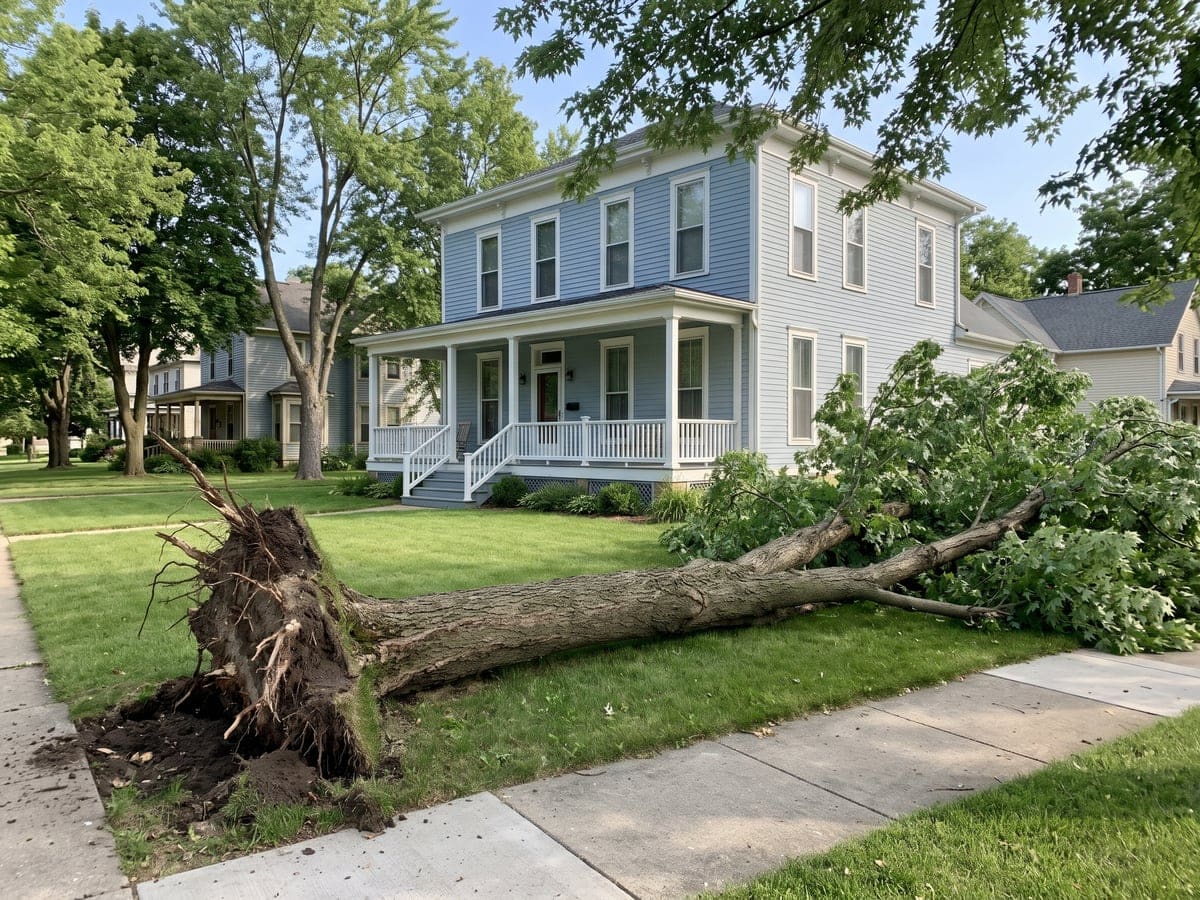
When a tree poses a threat to health, safety or property and needs immediate removal, such as one that has blown over or been struck by lightning, the city may give verbal authorization, and the tree may be removed without a written permit, with a written record made of the authorization.
Elgin's 2013 Forestry Quick Guide2 notes that a tree within 10 feet of an electrical line must be maintained by ComEd. When a limb or tree is touching or resting on a power line, treat the wire as live, stay well back, and keep everyone else away. If a line is down, sparking, or burning, or if anyone has been injured, call 911.3 To report a limb pressing on a ComEd line,4 call ComEd at 1-800-334-7661.
Elgin's tree bank
The code defines the "parkway or tree bank"2 as the portion of the public right-of-way not improved by a street or sidewalk. The city maintains trees on city property,5 including parks and the treebank between the sidewalk and the curb, and it does not maintain trees on private property.
Trimming, cutting, or removing any tree or portion thereof in the public right-of-way without approval from the Department of Public Works is unlawful. To request tree trimming services or to report an unsafe city tree, contact the Land Management Division of Public Works by calling 311. The city trims parkway trees year-round. After a tree is removed, stump grinding on the right-of-way comes separately, the 2013 Forestry Quick Guide2 says, with a JULIE locate done first; the work can take several months, and topsoil and grass seed go on the right-of-way after stump removal, not sod.
Private limbs over the right-of-way
Trees on private property are the owner's responsibility, the 2013 guide2 notes, including limbs growing over city rights-of-way.
The city's tree assessment page6 defines a risk tree, for its public tree assessments, as an entire tree or defective tree part that poses a high risk of injuring people or damaging property if it fails or fractures; a tree is not considered high risk unless there is a nearby target it could injure or damage.
Wind reports in Elgin
In NOAA's Storm Events Database,7 43 of 52 thunderstorm wind report rows for Elgin from 1996 through 2026 name trees, limbs or branches.
NOAA records a July 21, 2017 entry placed 1 mile northeast of Elgin with gusts estimated between 70 and 80 mph, damaging hundreds of trees and closing roads blocked by fallen power lines. Extensive tree damage in the Elgin historic district, with trees uprooted and some left on houses, appears in the July 4, 2022 entry. On June 24, 2026, a NOAA entry records large trees blown down, some snapped, with limbs and power lines downed.
Ash and diseased trees under Elgin's code
The city's tree preservation chapter1 defines a diseased tree as one infected with Dutch elm disease or oak wilt, a tree that may serve as a breeding place for the Asian longhorned beetle, and ash infected with or that may serve as breeding places for the emerald ash borer. The city's emerald ash borer page8 describes the insect as a wood-boring beetle whose larvae bore into the cambium and disrupt the tree's water and nutrient pathways.
Separately, Elgin's health and safety code9 declares elm and zelkova trees infected with Dutch elm disease (as confirmed by laboratory analysis) a public nuisance. An owner may not keep such a tree more than 10 days after the city notifies them of the infection. If the owner does not act, the city can do the work and recover its costs.
Setting out brush in Elgin
Elgin collects bundled brush10 tied with biodegradable twine or string in bundles no more than 5 feet long, 2 feet in diameter and 45 pounds; it will not collect branches thicker than 2 inches.
Elgin's homes
The Census Bureau's American Community Survey puts Elgin's median housing year at 1977,11 with about 7,659 of the city's 40,523 units (roughly 19 percent) built in 1939 or earlier. Detached single-family homes12 make up about 62 percent of the housing stock, with about 5,641 attached single-family units and about 3,772 in two-to-four-unit buildings. About 72 percent of households own their unit.