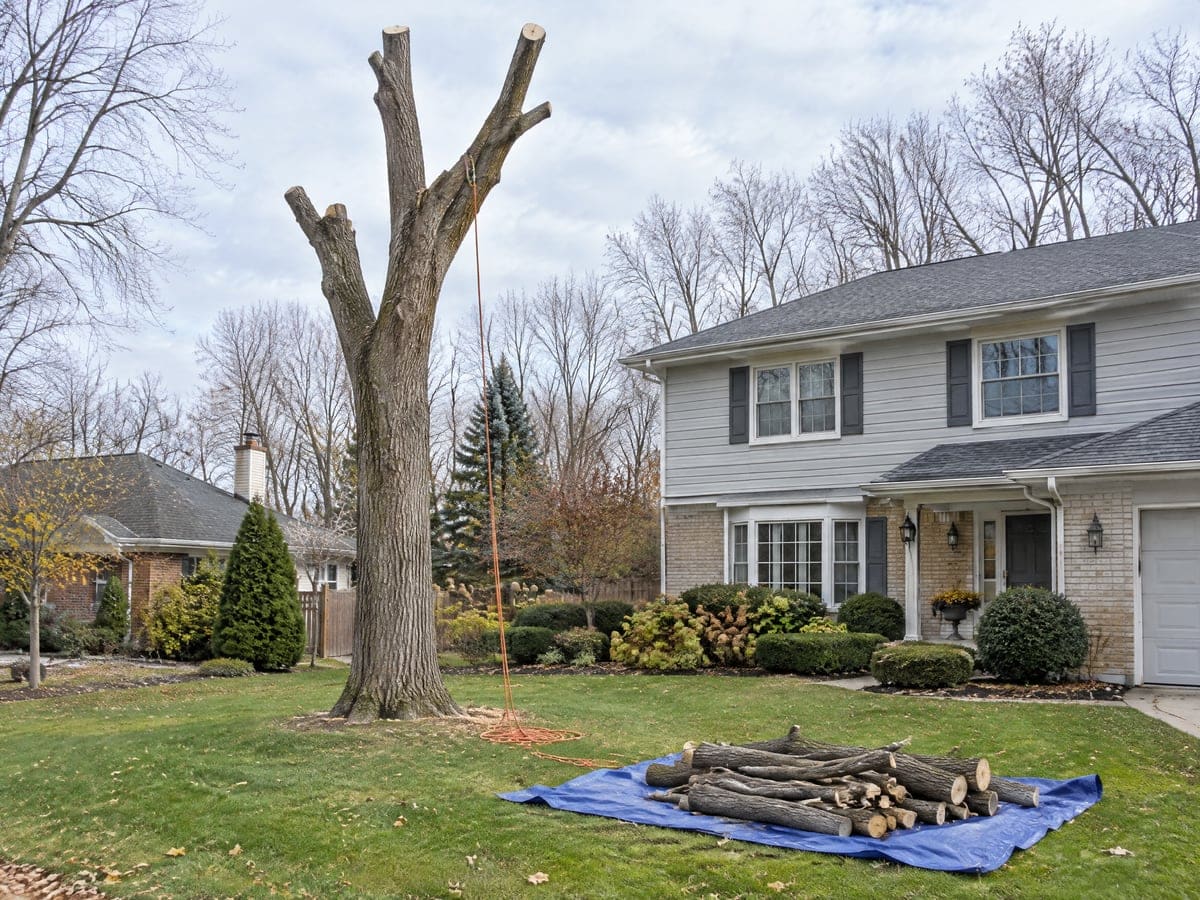
Does this tree really have to come down?
The first question is whether the tree can be kept. Most of what tells us the answer is visible from the ground, if someone looks at the whole tree instead of only the branch that worries you.
What the tree would hit if it fell
We stand under the drip line and look up, then step back. The house, the garage, the fence, the driveway, the deck, the air conditioner, the neighbor's shed: we note each one and the arc the tree would take toward it. Wires change the plan on their own.
Dead wood, cracks, cavities and mushrooms at the base
Dead branches break first, so we count them. A crack from a union is the fork tearing. A cavity shows how much sound wood is left to hold the top. The Morton Arboretum lists mushrooms at the base of a tree as a sign of internal decay.1
The lean, and whether it changed
A tree that started leaning this year, with lifted soil on one side, is on the move. We ask when you first noticed it; the answer often decides the schedule.
Room around the tree, and access from the gate
Under the tree and around it, the visit notes lawn, flower bed, fence, driveway and deck. It reads the yard from the gate and the driveway too, so the plan matches the yard where the work will happen.
How symptoms match the usual work
| Symptom | Likely cause | What it usually needs |
|---|---|---|
| A dead top on an ash | Emerald ash borer | Full removal |
| A split running down from the main fork | A tight V union under load | Removal, or cabling if the wood below is sound |
| A lean that got worse this year | Root failure or wind loading | Removal |
| Soil heaving on one side of the trunk | Roots lifting under the lean | Removal; the tree is already failing |
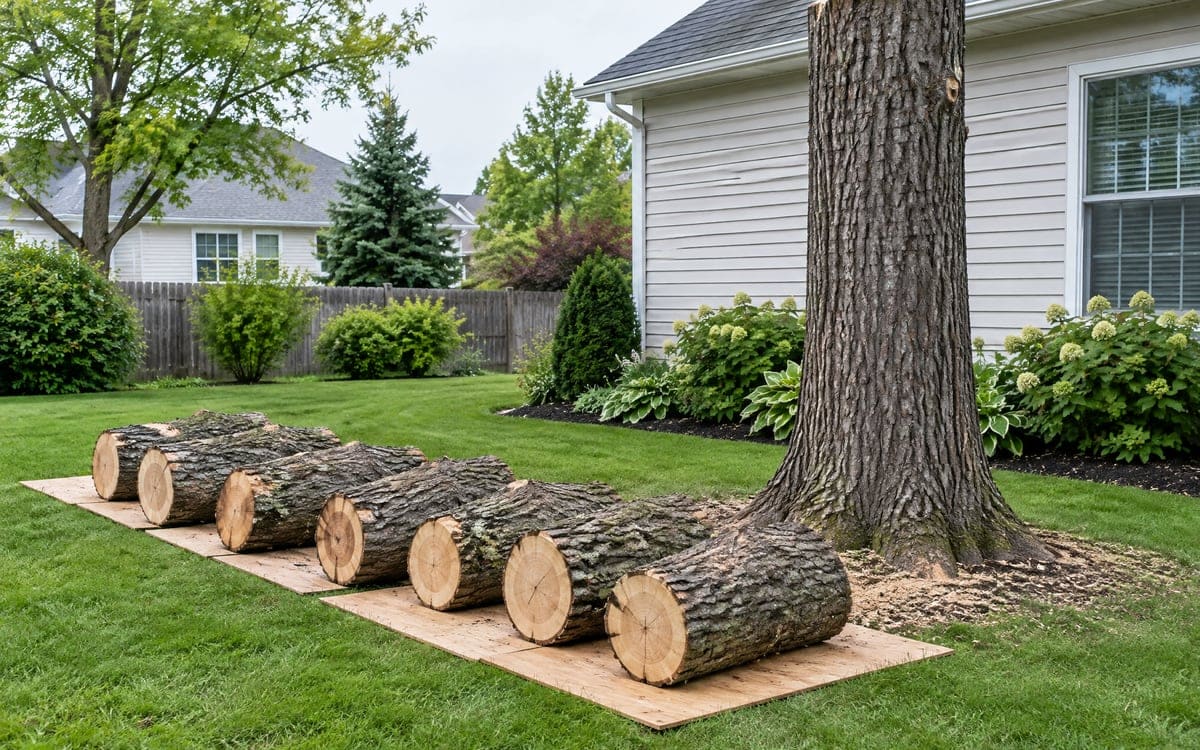
| A tree crowding the house wall | Planted too close, or outgrew the spot | Removal in sections |
| An ash shedding bark in sheets | Ash borer, late stage | Removal; dead ash is unpredictable |
For a split we might save, see cabling a split instead. For an ash that died standing, dead and dying tree removal covers how those come down.
Save it or take it down
We would rather keep a tree in the yard when the yard can keep it safely. The split between keeping a tree and taking it out usually comes down to the root plate and the main trunk.
When we suggest keeping it
- The crown has died back, but the trunk and roots are sound and most of the live wood is in good shape.
- The problem is a few dead branches or one crossing branch; a careful prune will do.
- A tight fork has a seam but no decay below it, and a cable can lower the strain enough to keep the tree.
If any of that sounds like your tree, start on the second look before it comes down page.
When it should come down
- The main trunk is cracked through, or decay has left too little sound wood to hold the top.
- The roots are lifting, or the tree has started leaning this year.
- A dead tree sits above a target you cannot move.
- A disease has already killed most of the crown.
What we read in the crown and at the roots tells us whether the tree still has the structure to hold itself up.
The visit, from the call to the yard
Call (847) 201-4879 and describe the tree, where it stands and what it is doing. If there are wires nearby, say so. The tree gets a walk around before any cut, noting targets, access and decay. What moves a quote is on the removal price guide.
Tree removal in Hoffman Estates: the Village side
Trees here come under two owners. The Village owns and maintains the parkway trees2 in the strip between the sidewalk and the curb, and trees on private property are the homeowner's responsibility.2 Under the code, no person, firm or corporation other than Public Works or a Village contractor may remove a street tree without a permit from the Director of Public Works,3 and the request needs a written reason, approved driveway and building permits, and a Village review and site inspection. Once that permit is issued, the permit holder pays for removing the tree and stump, restoring the parkway grade and turf, and a replacement cost by trunk size measured 54 inches above grade.3 The code sets out the grounds on which a tree removal permit is to be approved and requires every removed tree to be replaced as it specifies.3
For private land, the code bars removing any tree 3 inches or more in diameter without Village Board approval or a permit from the Assistant Village Manager of Development Services, on land other than developed detached single- or two-family lots under one acre, and for any removal in a right-of-way.3 Development Services answers permit questions for a particular lot. For a wider driveway, a street tree within 36 inches of the finished apron edge has to come out before construction.3 See the tree rules page for more.
Two Village rules reach a tree removal
A street tree and a tree 3 inches or more in diameter fall under different sections of the Village code.
Street tree
- Only Public Works or a Village contractor may remove one without a permit from the Director of Public Works.
- The permit request takes a written reason, approved driveway and building permits, and a Village review and site inspection.
Any tree 3 inches or more in diameter
- Removal needs Village Board approval or a permit from the Assistant Village Manager of Development Services.
- Developed detached single- or two-family lots under one acre are not covered by this section.
Sources: Village of Hoffman Estates Municipal Code, Chapter 10, Section 10-4-8 (Tree Removal), via Municode; Village of Hoffman Estates Municipal Code, Chapter 10, Section 10-4-7(B)(1)-(2) (Tree preservation), via Municode.