What is wrong with this tree?
An assessment is a close look at the crown, the trunk, the base and roots, the species and what the tree could hit.
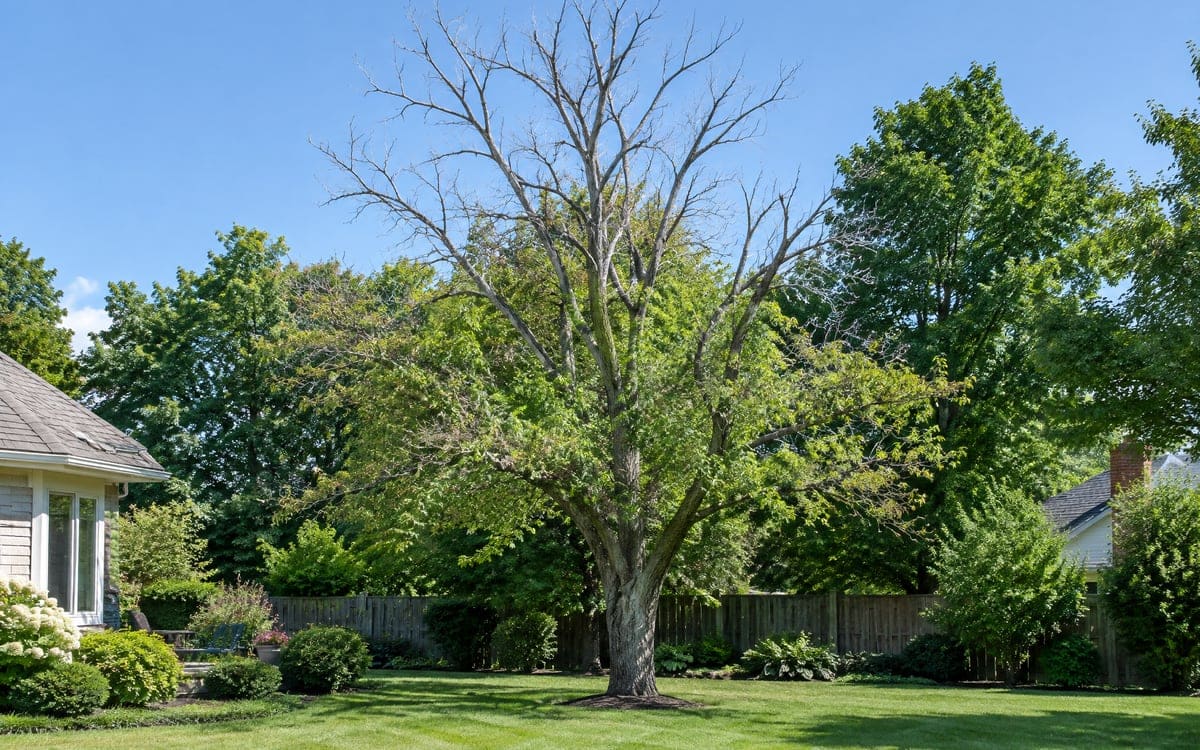
The crown: thin leaves, dieback from the top, dead limbs
A see-through crown that should be full in July is the first thing to notice. On an ash, bare branches at the top are a textbook sign of trouble; emerald ash borer attacks healthy ash of any size, and infested trees may die within two to four years, with dieback usually starting at the top.1 On a red oak, a sudden brown look through the upper crown in midsummer points another direction.
Trunk: cracks, cavities, loose bark, seams
Every face of the trunk gets a slow look. A long crack running down from a fork is louder than a short one; a seam that oozes or stays wet after a dry week is a red flag. Loose bark that peels off in sheets, especially on ash or elm, usually means the wood under it is dead.
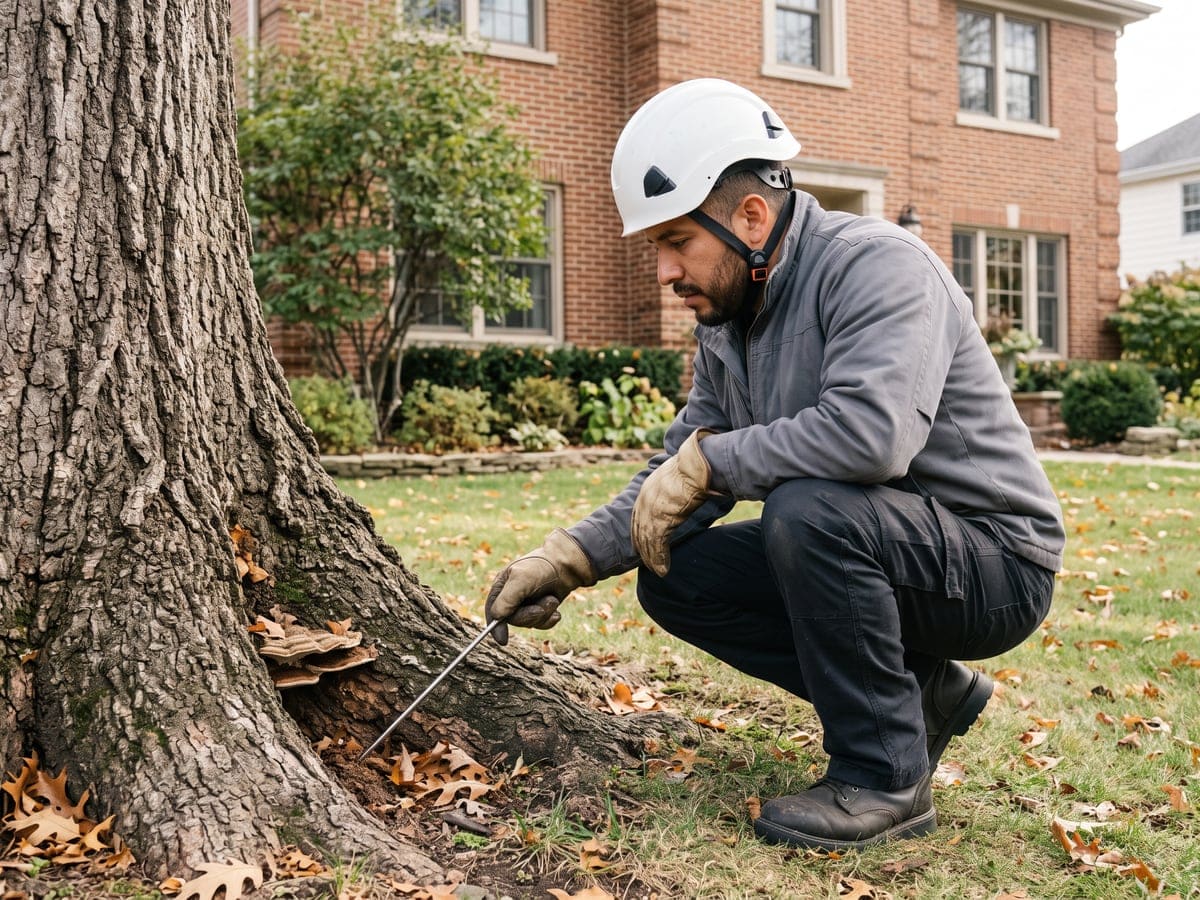
Base and roots: mushrooms, heaving soil, cut or buried roots
The Morton Arboretum lists mushrooms at the base of a tree as a sign of internal decay.2
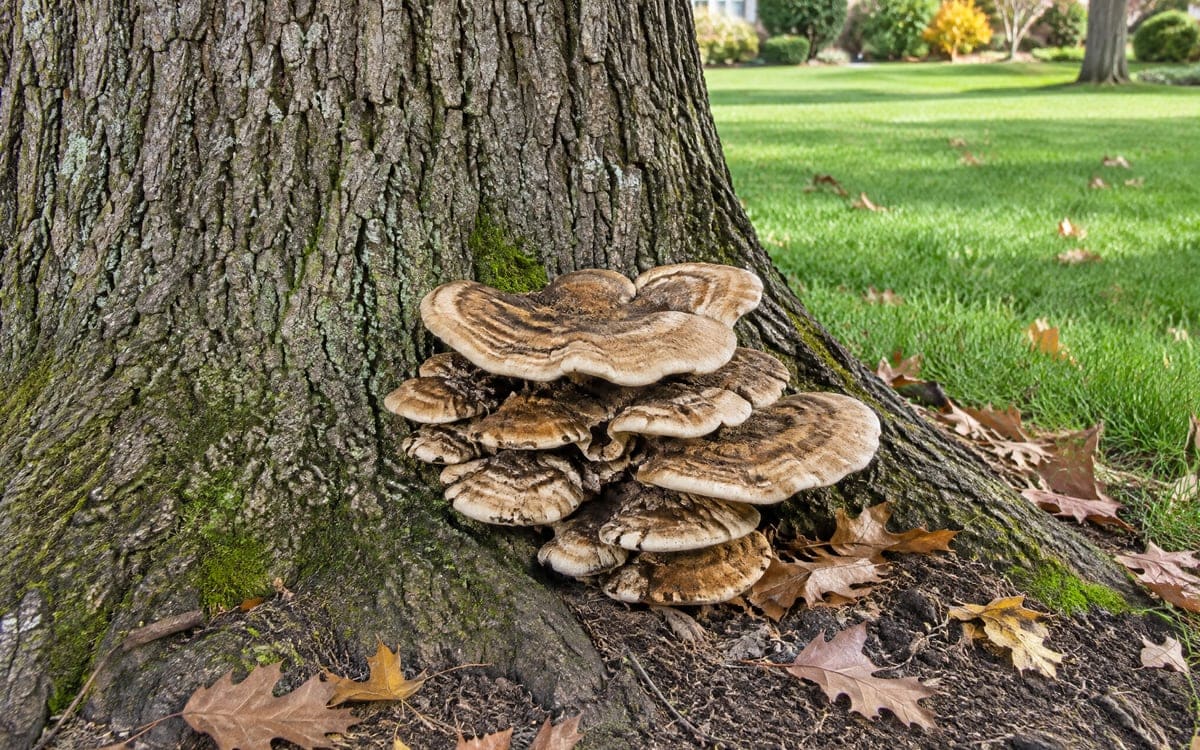
Soil heaving on one side after wind, or roots cut by a trench a few seasons ago, both mean the tree is holding on with less than it had.
Signs of a hazard tree
The Morton Arboretum lists these as signs of internal decay and other potential hazards.
Signs of internal decay
- Mushrooms at the base of a tree
- Carpenter ants
Other signs of potential hazards
- Large dead branches
- Cavities
- Cracks where branches attach
- Roots that have been cut or covered
Source: The Morton Arboretum, Trunk Wounds and Decay (Hazard Trees tab).
Species and what attacks it here
Oak wilt turns up in all Illinois counties, and trees in the red oak group (red, black, pin, scarlet) usually die within weeks or months of infection, while white and bur oaks decline more slowly;3 most new oak wilt infections spread through root grafts between oaks growing within about 50 feet of each other,3 so a sick red oak puts the healthy oaks around it on the list too. American elm is extremely susceptible to Dutch elm disease, while Siberian elm is highly resistant.4
What it could hit
The last part of the walk is the yard around the tree. The house, the garage, the driveway, the fence, the neighbor's roof, the service wire from the pole to the meter: everything within a radius of a full tree length is in the picture.
| Symptom | Likely cause | What it usually needs |
|---|---|---|
| Dieback at the top of an ash | Emerald ash borer in late stages | A removal plan |
| An oak browning in July | Oak wilt in a red oak | Removal before spore mats form, and a look at nearby oaks |
| Shelf fungus at the base | Root or butt decay | A probe and a decision on removal |
| A crack below a fork | A weak union with a split starting | Pruning for weight, cabling the fork or removal |
| Bark falling away from a dead-looking trunk | A dying tree, often ash or elm | Removal before the wood turns brittle |
| A tree a backhoe passed close to | Root loss from construction | Watch it for changes and call for another look |
| An American elm wilting fast through the crown | Dutch elm disease | Removal, and attention to the elms nearby |
Can we keep it, or does it come down?
Not every troubled tree is a removal, and we would rather keep a tree in the yard when the yard can keep it safely.
When we can keep it
- A healthy tree with a prunable defect: a long low limb, a rubbing crossover, a batch of deadwood
- A fork with a crack that fits a cable and brace
- A tree with cosmetic damage, like leaf skeletonizing from Japanese beetles, that will leaf out again
- A root loss where the top can be reduced to match what the roots can still carry
When it should come down
- An ash in late-stage decline with the top gone
- A red oak with wilt
- A trunk with a long split past the main fork, or a cavity through more than half the stem at breast height
- A tree leaning more each year with soil lifted on one side
The call at the yard is from the ground, with the time to walk the full circle. The decision rarely comes from one thing; the tree, the species and the target add up to it.
Checking credentials on anyone looking at your tree
Tree assessment credentials exist, and the groups that issue them keep public lists. Ask for the full name of the credential, the number and the issuing group, then look it up on that group's own page. The stamp on a shirt or a truck is not proof on its own. Our guide to hiring any tree service covers the other questions worth asking.
How an assessment visit sets up
On the call, say what you are seeing (dead limbs, a lean, mushrooms, a crack), roughly how big the tree is, what stands under it and whether a line is near it. The yard side of the visit is a walk around the tree, with the back side as well as the front; most of the time is slow circles, not a tool.
At the tree, the options on the table get named plainly: pruning out dead wood, cabling a fork, or a removal in sections.
Tree health around Hoffman Estates
The Village's Forestry Division inspects public trees for disease, decay and structural problems,5 with Village arborists deciding on treatment, trimming or removal; a resident who thinks a parkway tree is declining can ask Public Works to look. Parkway trees are a different call than one to us, and the tree rules page sets out who handles what on a street tree.
The Village calls Japanese beetle damage mostly cosmetic6 and does not treat Village-owned trees for it.
On lots where construction has moved dirt near a kept tree, the code keeps grading and construction equipment, fill, soil and debris out of each kept tree's root zone7 when a Tree Preservation Plan is in place. Hoffman Estates' tree canopy sits at 28 percent, up from 26 percent between 2010 and 2017,8 with the most canopy in natural areas and on residential properties.