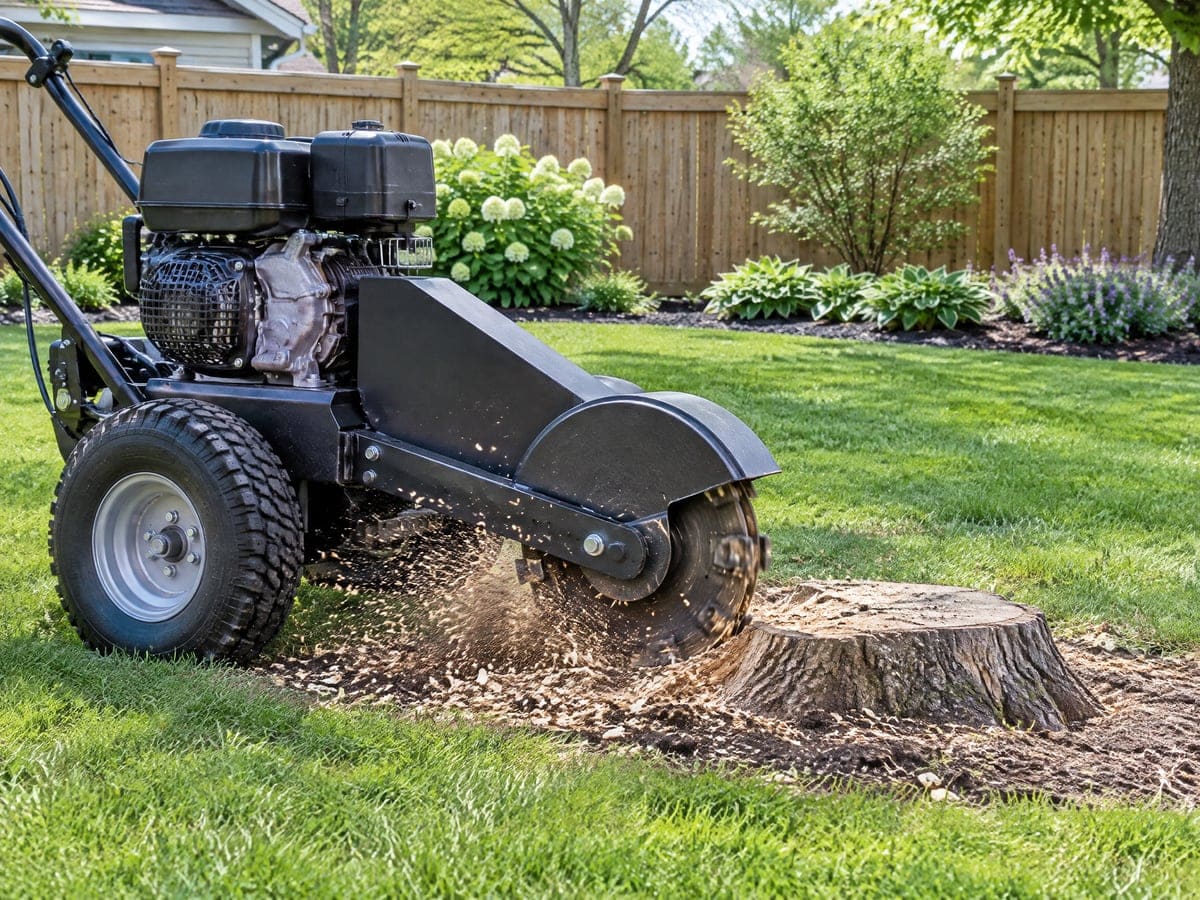
What is under that stump?
A stump above the grass is easy to see. The roots, and anything buried near them, are not.
How wide the stump is and how high it stands
A stump cut flush at the lawn is easier than one left a foot tall from an old removal, because the top of the wood has to come down to grade before we start grinding into the roots.
Surface roots and how far they run
Roots that run along the top of the lawn can reach well past the drip line of the old tree. For a stump near a lawn you want level, we talk about how far out to grind: just enough to clear the mower, or wide enough to let you reseed clean.
What is buried near the stump
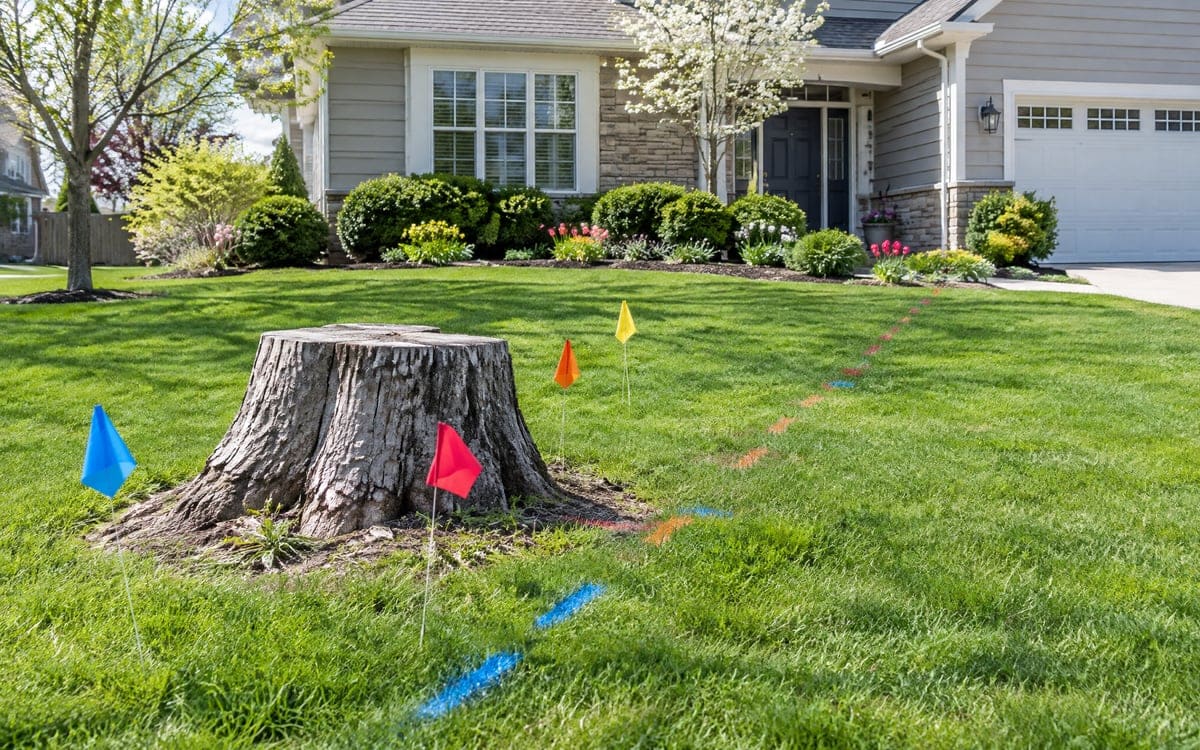
Before any grinder digs, Illinois law requires anyone planning outdoor digging, whatever its depth or size, to notify JULIE at least 3 days ahead; the request is free and can be made by calling 811 or online,1 and the person doing the digging makes the request.1 On a crew grinding job, that is the crew's call. JULIE marks the lines its member utilities own, but private lines such as sprinkler lines, private lighting and secondary electric lines to detached garages are not marked by them.1 Those are worth walking before the first grind: where the sprinklers run, whether a line ever reached a detached garage, whether anyone remembers trenching across the lawn for landscape lights. The gate and the walk from the gate to the stump are also part of the visit.
What comes next
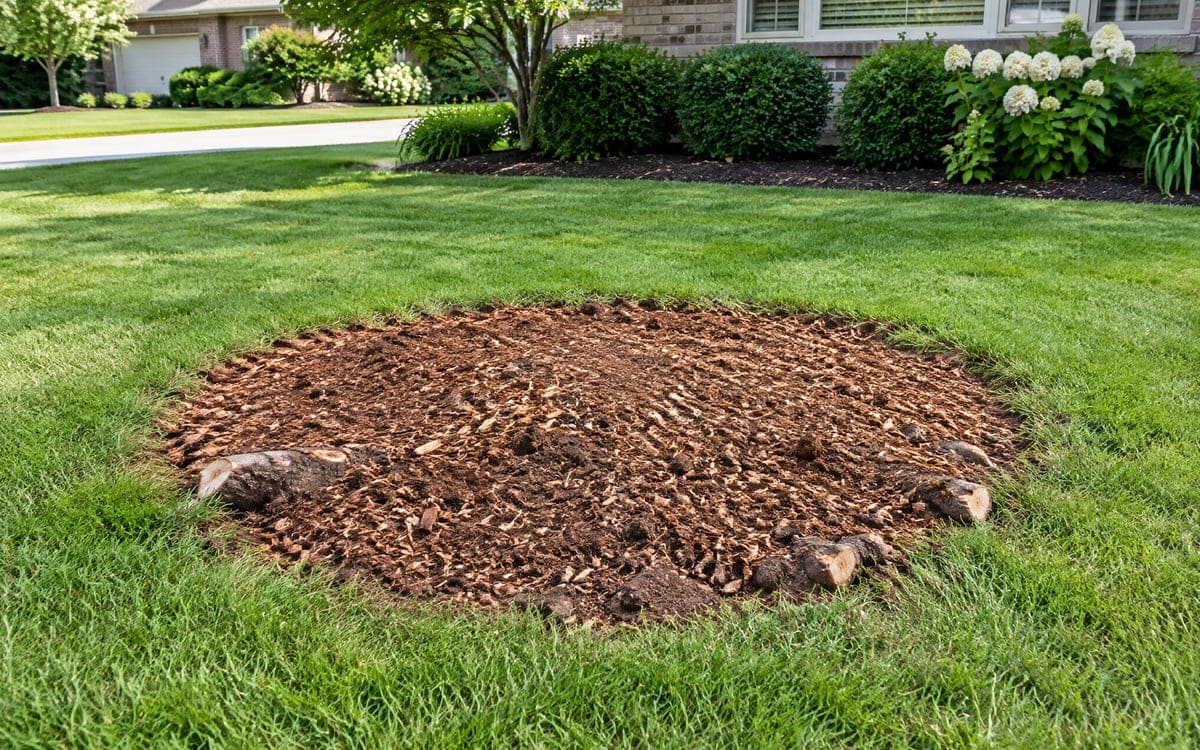
Grass over the spot, a new bed, a new tree: each one changes what the ground has to look like after the grinder. For a lawn, most of the chips come out and the hole is backfilled with soil for seed or sod. For a new tree, see planting in the same spot for what the chips have to come out of first.
How symptoms match the usual work
| Symptom | Likely cause | What it usually needs |
|---|---|---|
| A fresh stump from last week's removal | The removal stopped at the ground | Grinding below the soil line |
| An old soft stump you can push with a boot | Years of decay | Grinding below the soil line |
| Sprouts coming off the stump | The roots are still alive | Grinding wide of the stump to pull the root flare out |
| Surface roots in the mower's path | A mature tree had a shallow root plate | Grinding the stump and the ridge roots back below the grass |
| A stump against a fence or foundation | Planted or self-seeded in a tight spot | Grinding to grade |
| Several small stumps across a lot | Volunteer trees, past clearing, storm losses | Grinding each stump below the soil line |
For a stump next to a bigger project, see several stumps and brush at once. For stumps from ash trees that died in your yard, stumps from ash trees covers the usual sequence. For a stump still attached to a standing tree, the work starts on the removal that left the stump page.
Grind it, or take the whole root out
When grinding is enough
- The lawn only needs to clear the mower and let grass grow back.
- A new bed is going in and the chips can mix with the mulch.
- Sprouts are the main complaint; grinding wide pulls the live tissue out.
- The spot is close to a fence or wall, and digging a hole for the root ball would do more damage.
When the whole root ball has to come out
- A new structure is going over the spot: a patio, a garage pad, a shed.
- A hole for a replacement tree needs to sit where the old root ball sits now.
- Soil has to meet grade across the whole root plate for drainage reasons.
Those are excavation jobs, not pure grinding, and we tell you so on the visit.
Can a homeowner grind a stump?
A grinder throws wood chips and small stones at high speed, the wheel can catch on a buried root or a stone and kick, and the law on buried lines applies to anyone with a shovel or a grinding wheel. For those reasons, stump grinding goes to a crew with the machine and the JULIE ticket, not a Saturday project.
The visit, with JULIE first
Call (847) 201-4879 and tell us where the stumps are, roughly how wide and high, what is near them and whether gates reach the backyard. Illinois law puts the JULIE request on whoever is doing the digging, and nothing is ground until the locate waits are up. Private lines (sprinklers, yard lights, a garage feed) sit outside what JULIE marks, so where those run is worth walking too.
Stump grinding in Hoffman Estates: what to know about pickup and locates
The Village does not take stumps or root balls from the curb. Branch pickup takes tree branches, shrub trimmings and similar brush up to 8 inches across and 10 feet long, but not stumps, root balls, firewood or lumber,2 and tree trunks, stumps and large limbs are not taken as yard waste either.3
Inside the locate marks JULIE makes, the tolerance zone is 18 inches on either side of a marked line plus the line's width; inside that, JULIE says to dig beside the marks by hand, pot-holing or vacuum excavation.4 Grinding stays outside that zone.
What JULIE asks before any outdoor digging
Illinois law requires anyone planning outdoor digging to notify JULIE; JULIE's tolerance zone is 18 inches on either side of a marked line, plus the line's width.
At least 3 days
Notice to JULIE before any outdoor digging
18 inches
Tolerance zone either side of a marked line, plus the line's width
Source: JULIE (Illinois one-call), What is the Tolerance Zone?