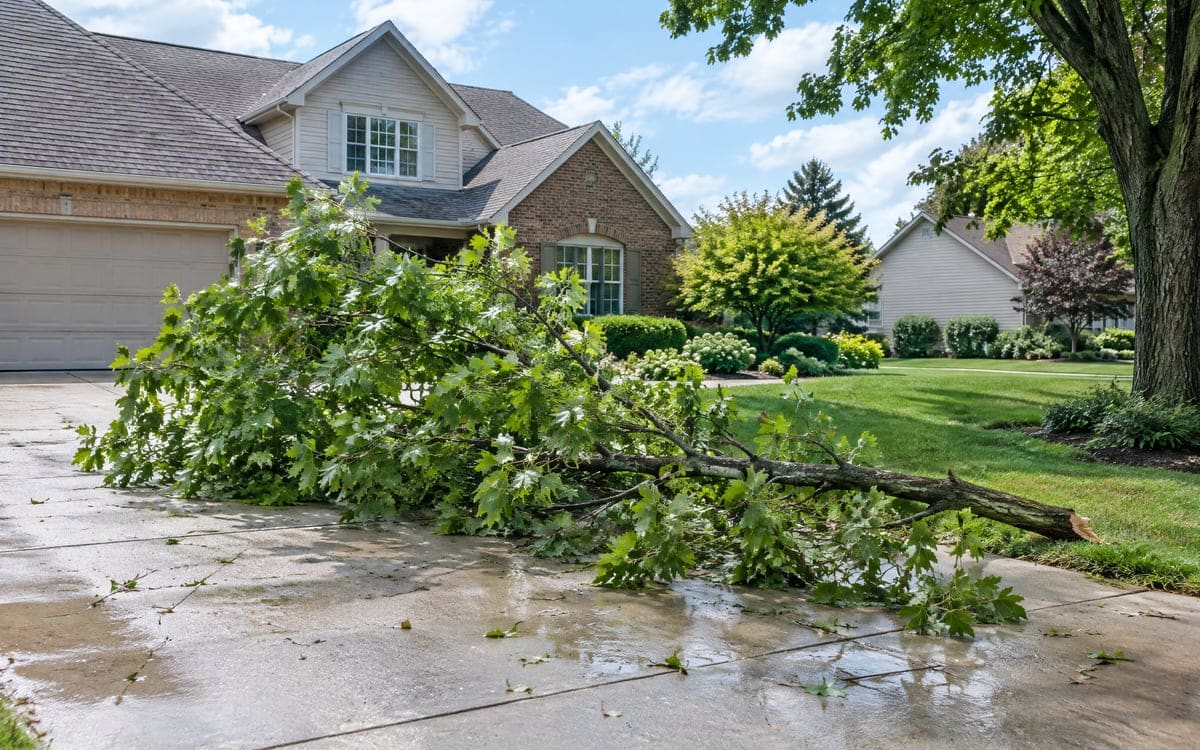
Any wire in a tree is live until ComEd says otherwise
The first rule after a storm is also the hardest to follow when a branch is lying across a familiar driveway: assume every wire is energized. ComEd warns homeowners not to climb or trim trees near power lines without precautions, says hiring a qualified contractor is safer, and notes that even brief contact with a line, or a branch touching one, can severely injure or kill.1
That rule covers a branch resting on the service wire to the house, a cable brushed by a leaning tree, and the line between poles out back. Nothing a homeowner can see from the ground tells them whether a particular wire is live. ComEd's own crews treat it as live until they have confirmed otherwise.
911 comes first when someone is hurt or a line is down or burning
Before any call to a tree service, 911 is the number for an injury, a downed wire or a wire that is sparking or burning. For a limb on a line that is not down and no one is hurt, ComEd asks anyone who sees a broken limb lying on a power line, or likely to fall on one, not to touch it and to report it at 1-800-334-7661.2
Once ComEd knows about the line and emergency services are on their way, storm and emergency tree work is the next call. A tree touching a wire stays off limits to a private crew until the line side is handled.
A limb hung in the crown
Standing wood is predictable in a way that a broken limb hung high in a tree is not. A limb that broke in the wind but did not fall is holding by bark, branches below it or sheer luck, and any wind, any animal or any vibration from a saw can drop it onto whatever is under it, which includes a homeowner who walked over to look.
The right response is to clear the ground under the tree and let a crew handle it. A hung limb cannot be pulled down safely from the ground with a rope, and the yard under it is not a place to stand while deciding what to do. Storm work on a limb like that is a different job from a planned pruning.
Photos come before anything moves
Before anyone touches anything, photos from a safe spot help in two ways. They capture what the tree was doing when the storm ended, which matters if an insurer asks. They also help you describe the job when you call us.
Pictures from the sidewalk, the back door and the far side of the yard are enough. There is no reason to climb over anything to get a better angle. If the only clear picture would mean standing under the damage, that picture is not worth the risk.
ComEd clears its equipment and leaves the wood
Once the utility has the call on the lines, their crews will do what they have to do to get power back on. ComEd cuts and removes trees and branches from its own equipment, but disposing of the branches, logs and other debris is the customer's responsibility;2 ComEd says it cannot help with debris removal.
That is why a yard can look worse the morning after power comes back. The lines are up, the wire is tight, and the wood sits in a pile where it fell. ComEd's job is the equipment, the wood is the owner's, and a crew is who hauls it. Trees and other vegetation cause about 21 percent of all electric service interruptions on ComEd's system,3 which is one reason their storm response is aimed at the lines before the wood.
Village pickup takes branches, not trunks
Smaller storm brush can go out with the Village's scheduled pickup. The Village's spring and fall branch pickup takes tree branches, shrub trimmings and similar brush up to 8 inches across and 10 feet long,4 with willow kept separate, but not stumps, root balls, firewood, lumber, leaves, grass or sod. In 2026, the spring round began Monday, April 20 and the fall round Monday, September 21,4 with branches due at the curb by 7am on the Monday of the zone's week.
Yard waste works in parallel for smaller pieces. Brush with yard waste must be bundled at no more than 50 pounds, 5 feet long and 24 inches across, with no limb thicker than 3 inches.5 Anything larger, including a trunk or a stump, is a job for a crew with a chipper or a truck.
A broken parkway branch is a different story. The Village's own guidance says residents should not trim parkway trees themselves6 and should call Public Works about broken, hanging or storm-damaged branches. That call goes to the Village, not to a private crew.
Ice storms break limbs too
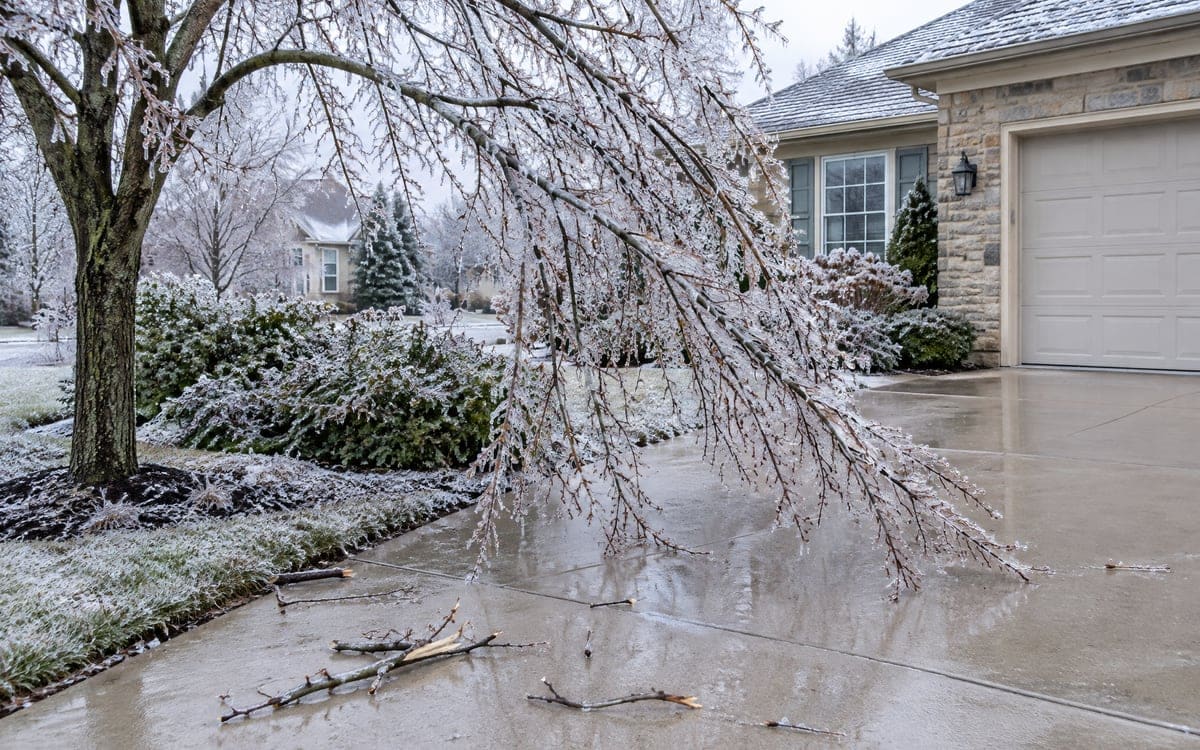
Not every storm is a summer wind event. Heavy ice loads during ice storms can break limbs or ruin whole trees and bring down power lines,7 and damaging ice storms happen throughout Illinois even though central Illinois sees more freezing rain days than the north.
An ice-loaded limb is still live and still under tension when the ice begins to melt. A branch that looks like it has survived can snap on a sunny morning after a cold night. The post-ice check matters as much as the one after a wind event, and it is the one more people skip.
The June 10, 2026 derecho came within a mile
Big wind events do happen here. NWS Chicago's reports include a tree downed onto power lines 1 mile northwest of Hoffman Estates at 3:39pm on June 10, 2026,8 with gusts up to 80 to 85 mph and widespread wind damage across much of northern Illinois.
That one event is a reminder of what a derecho does in a few minutes. A damaged tree after a storm of that size is not a project for a Saturday afternoon with a borrowed chainsaw; it is a call for a crew.
A split tree still standing is not a safe tree
A trunk split down from the main fork, with both halves still upright, is tempting to leave alone. It should not be. Any wind can finish the split, and the two halves do not fall where the original tree stood. Sometimes a split tree can be saved with cabling when the split is small and the trunk below is sound; often it cannot, and the tree comes down.
Deciding which it is takes a look at the fork, the crack, the trunk and what the tree would land on. A split tree the day after a storm sits on the same list as a hung limb: keep people, pets and cars clear, and wait for a crew.
What we look at when we arrive
A storm visit starts with the same walk any other job does, slower. The read covers what the tree is touching (a wire, the house, a car, a fence), what it is resting on, whether it is still under load, any split or crack not visible from the street, and the ground on the uphill side of a leaning trunk, where the roots may already have lifted.
Taking a damaged tree down is sometimes the answer, and sometimes keeping it with careful pruning or a cable is, which the walk around the tree decides.
After a storm: what to do, who to call
| What you see | What to do now | Who to call |
|---|---|---|
| Anyone hurt, or a line down, sparking or burning | Stay back, keep others back | 911 first, then ComEd 1-800-334-7661 |
| A limb lying on a wire | Do not touch it | ComEd 1-800-334-7661 |
| A limb hung high in a tree | Clear the ground under it | A tree crew |
| A tree on the house | Keep everyone out of that part of the house | A tree crew; your insurer |
| A split trunk still standing | Keep clear of the drop zone | A tree crew |
| Brush at the curb within pickup size | Set it out by 7am on the Monday of the zone's week | Village branch pickup |
| A broken parkway branch | Report it; do not trim | Village Public Works |
| Wood left after ComEd clears a line | Leave it for a crew to cut and haul | A tree crew |