How often to water a new tree in a Hoffman Estates fall
A new tree is still trying to grow its first set of local roots. Watering on a schedule is not efficient or reliable; the Arboretum advises tipping out an inch or two of soil with a hand trowel and watering only if that soil is dry.1 That rule holds in May and it holds in late October.
Weather frames the fall side of the job. Northern Illinois averages its first 32-degree reading on October 7 and its last on April 28, for about 160 frost-free days a year,2 but the ground stays open to water weeks longer than that first freeze suggests, and the watering routine runs with the soil rather than the thermometer.
The roots of a new tree are smaller than you think
The reason schedules fail is that a nursery tree does not come with the root system a mature tree carries. The root ball that arrived with the pot is what the tree is working with for its first few seasons, until it grows out into the surrounding soil.
During that stretch the tree cannot pull much water from any distance; it drinks from the soil within and just outside its root ball. Everything in the watering plan is built around that fact. Water goes where the tree can reach it, and the trowel check decides when.
Check the soil before reaching for the hose
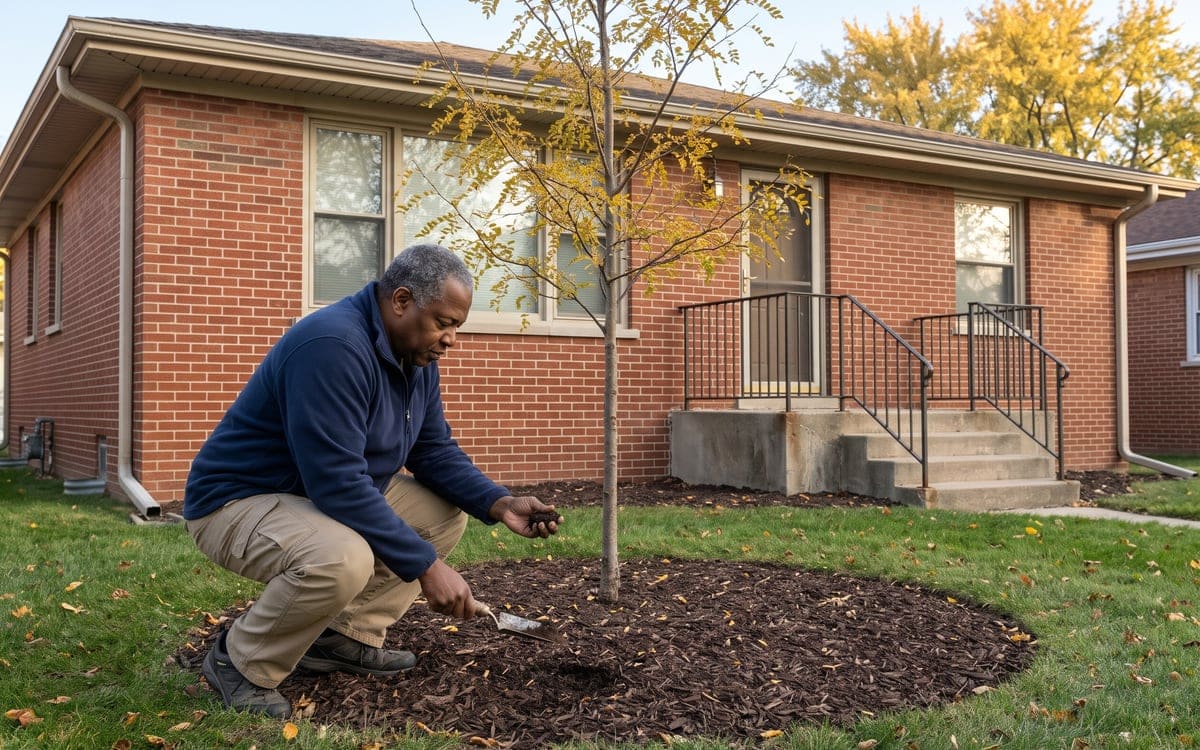
The trowel test is quick. Push the trowel into the soil at the edge of the root ball, lift a small plug, and feel it. Damp, cool soil that holds together is not thirsty. Dry, dusty soil that crumbles between the fingers is.
The test comes before each watering, not on a schedule. A hot spell leaves the soil dry sooner; a soaker rain or a deep watering leaves it damp longer.
Water deep, out at the drip line
Shallow watering trains shallow roots. Water deeply, so water goes at least five to six inches into the soil, rather than lightly and often, and water around the tree's drip line, under the ends of the branches, where the water-absorbing roots are concentrated.1
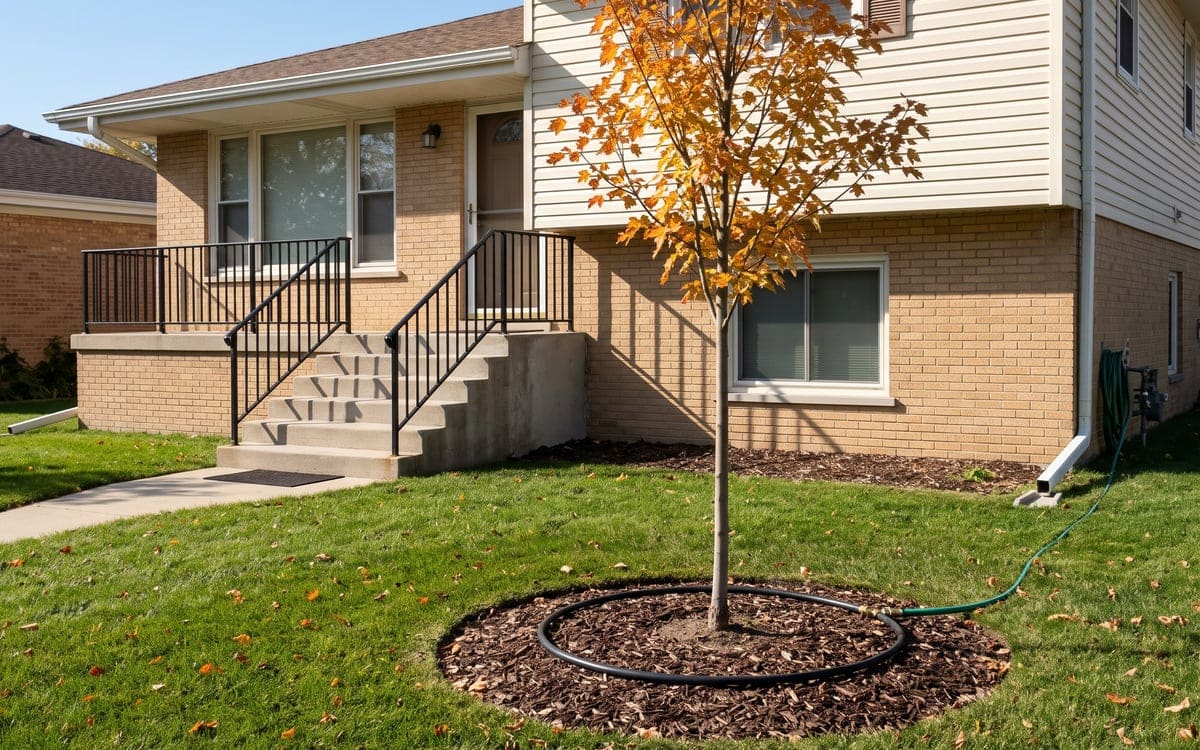
A soaker hose coiled around the drip line, run at low pressure until the water has reached that five-to-six-inch depth, puts water where the roots are heading. A soil check a few hours after the hose shuts off confirms the depth. A sprinkler aimed at the trunk puts water on the bark and loses most of the rest to evaporation.
An inch of water a week, two in sandy soil
For new trees and shrubs on most well-drained soil, the Arboretum says 1 inch of water per week throughout summer and fall is required, and as much as 2 inches per week in sandy soil.3
An inch across the root zone is more water than a quick spray delivers. A tuna can or a straight-sided cup set under the drip line while the hose runs shows how long the hose has to run to put down an inch; that is the yard's one-week number. Rainfall counts; a gauge in the lawn tells you whether to run the hose that week.
Autumn watering runs until the ground freezes
Fall watering is the step most new trees miss. The Arboretum says trees, especially newly planted ones and evergreens, need ample water as they prepare for winter, and to keep watering as long as the soil is not frozen and can accept water, with no specific cutoff date.1
A dry autumn is as hard on a tree as a dry July. Don't stop watering in October. The hose comes off the spigot and goes inside when the ground has frozen hard enough that water pools and runs off rather than soaks in.
Mulch holds the water where it does the most good
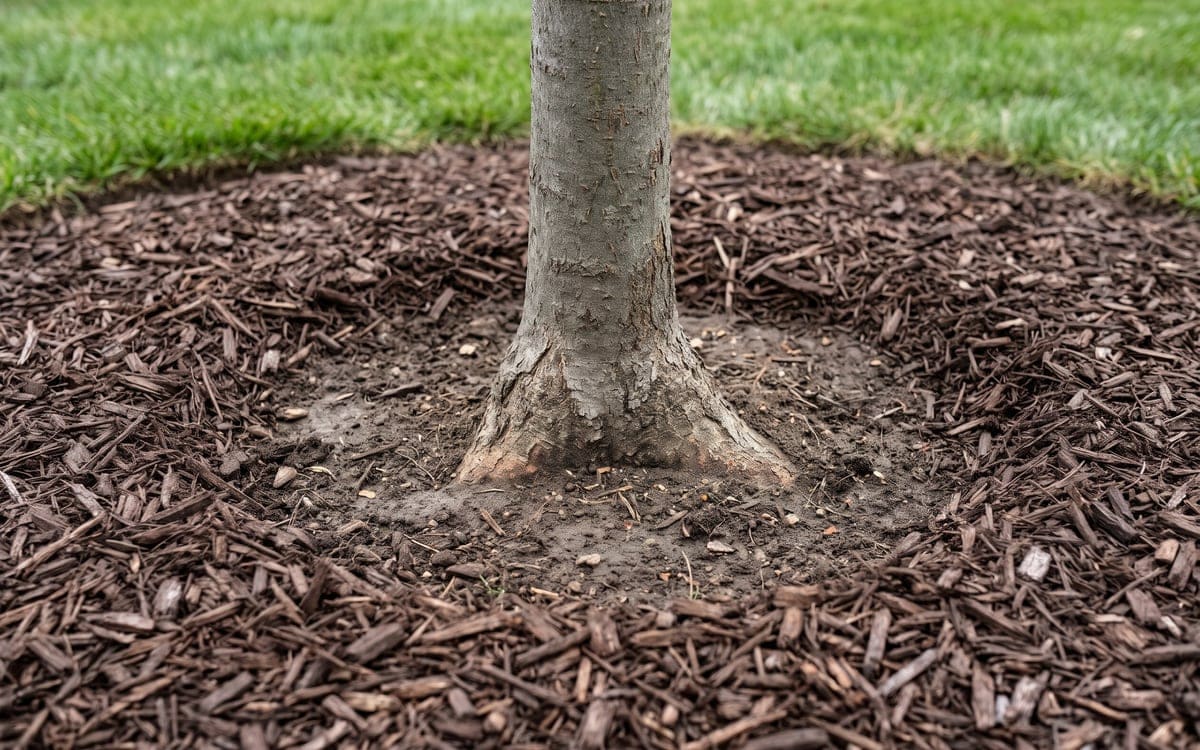
Water that soaks into bare soil also evaporates back out. A ring of chip mulch over the roots, pulled back from the trunk, slows the loss and shades the shallow roots.
The ring also keeps mowers and string trimmers back from the trunk, which is the other common way a young tree loses its first season. The mulch step is covered in the guide to planting after a removal, and it applies to any new tree, replanting or not.
Signs of too much and too little water
The two mistakes look different in the leaves. A thirsty tree wilts, then crisps at the leaf edges, then drops leaves early. A tree sitting in soggy soil yellows from the inside out, with leaves that stay limp instead of crisp and that fall off while still green or yellow.
| Signs on the tree | Likely cause | What to adjust |
|---|---|---|
| Wilted leaves, dry soil at the root ball | Not enough water | Water deeply, then check the soil before the next watering |
| Crispy brown leaf edges, dust-dry soil | Not enough water over a longer stretch | Return to a weekly inch and mulch the ring |
| Yellow leaves across the whole crown, soggy soil | Too much water or poor drainage | Let the soil dry past the trowel test before the next watering |
| Mushy roots at the surface, foul smell | Standing water in the root zone | Pull back watering; look at drainage around the hole |
| Leaves drop early with no color change | Stress, often watering related | Match the amount to the trowel test |
A young tree that looks worse rather than better after a round of watering is often one that was already wet. The soil check comes before the next round. If the tree keeps declining through the fall, a short visit to look at it catches a problem that watering alone will not fix.
New trees stay on this plan for two or three years
Watering a new tree is not a one-season job. Newly planted trees and shrubs may need regular watering for two to three years, until their root systems are established, and large transplanted trees and evergreens may take even longer.1 Through those years, the soil check is still what decides each watering. A tree that cannot carry itself after that stretch is one worth having a crew look at before another season goes by.