Hoffman Estates trees, housing and preserves
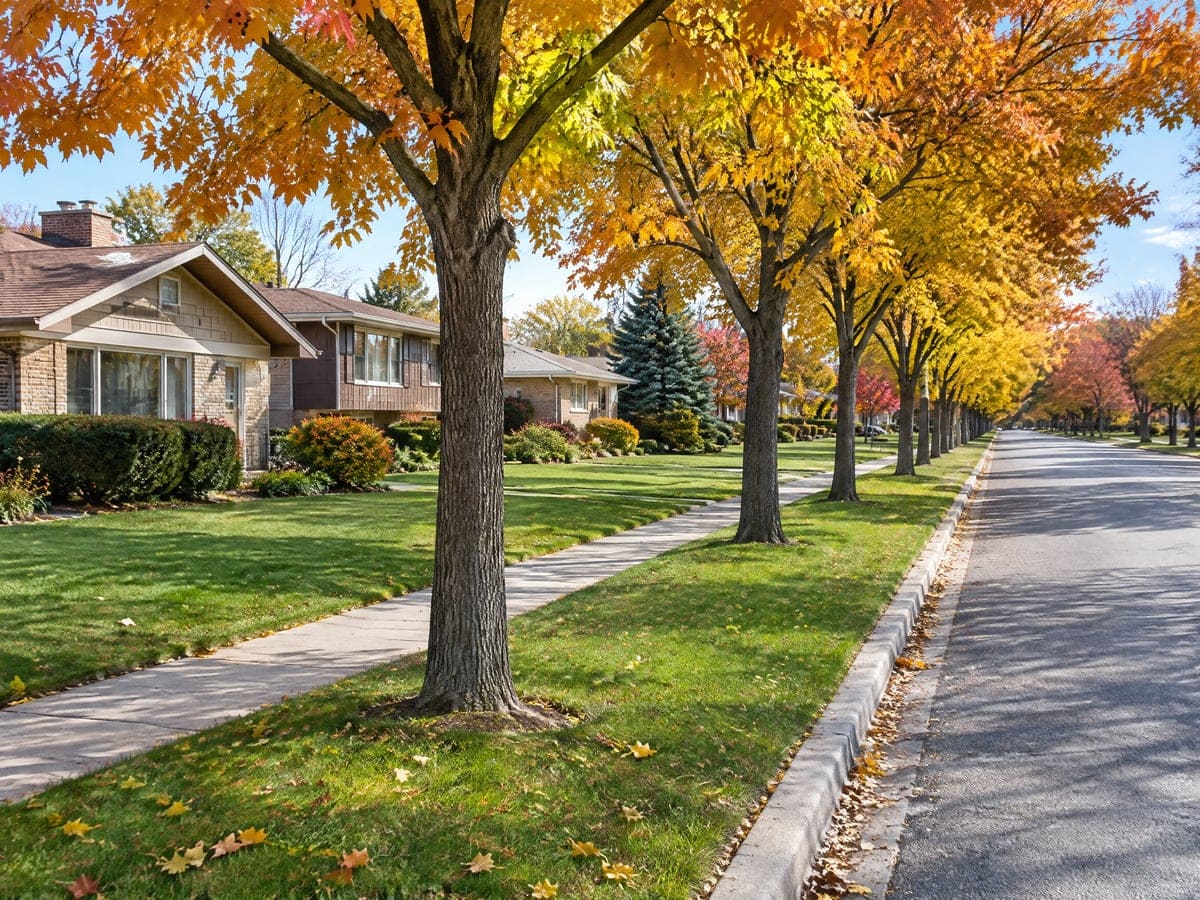
The village sits in two counties, with a mature housing stock and a large publicly owned tree collection.
| Fact | What it says |
|---|---|
| Counties | Cook and Kane1 |
| Tree canopy | 28 percent, up from 26 percent between 2010 and 20172 |
| Publicly owned trees | More than 17,0003 |
| Housing built 1950 through 1979 | About 61 percent4 |
| Ash removed by the Village | More than 6,0003 |
| Forest preserves | Paul Douglas Preserve5 and Arthur L. Janura Preserve6 |
Parkway trees belong to the Village
The tree between the sidewalk and the curb is the Village's, not yours. The Village says parkway trees are owned and maintained by the Village, with routine trimming every four to seven years, mostly in late fall and winter,3 and its tree care guidance says residents should not trim parkway trees themselves and should call Public Works about broken, hanging or storm-damaged branches.7
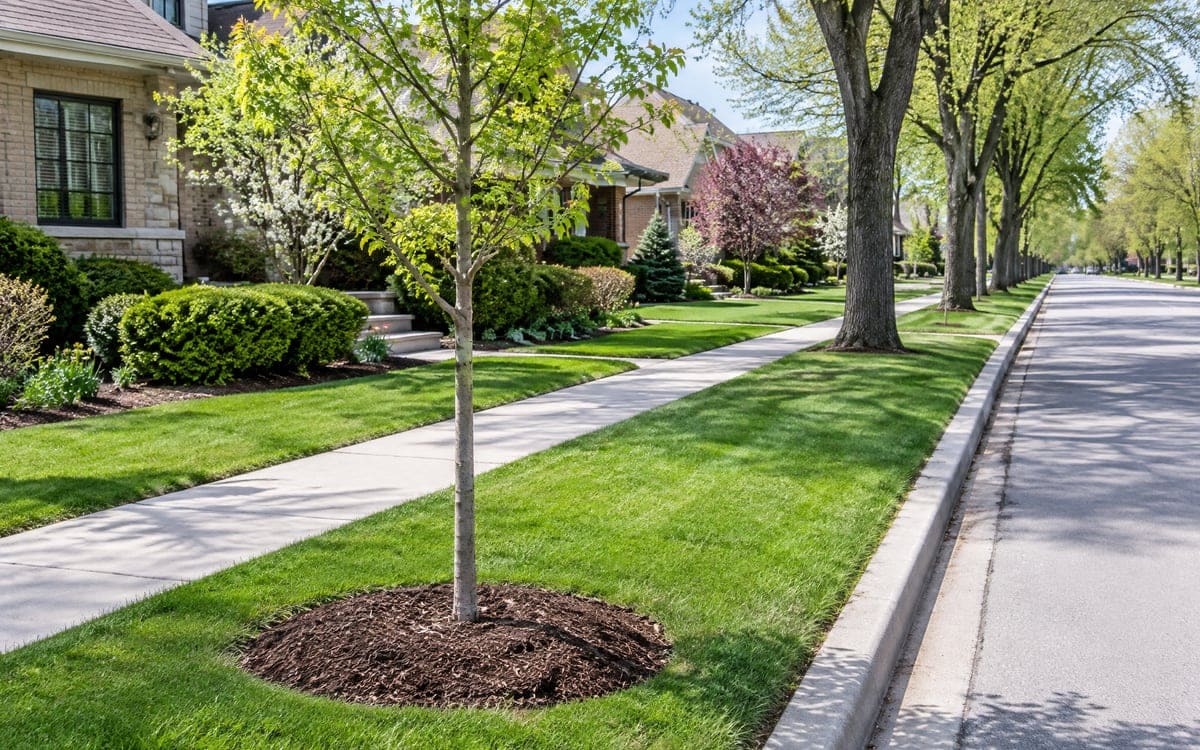
On removing a parkway tree, the code is strict. Under it, no person, firm or corporation other than the Public Works Department or a Village contractor may remove a street tree without a permit from the Director of Public Works; the request needs a written reason, approved driveway and building permits, and a Village review and site inspection.8 Once a street tree removal permit is issued, the code makes the permit holder pay for removing the tree and stump and restoring the parkway grade and turf, and charges a replacement cost by trunk size measured 54 inches above grade.8
What a street tree removal permit takes
The three parts of a street tree permit request to the Director of Public Works, under the Village code.
A written reason
The request names in writing why the street tree needs to come out.
Driveway and building permits
The approved driveway and building permits that go with the project come in with the request.
Village review and site inspection
The request needs a Village review and site inspection.
Source: Village of Hoffman Estates Municipal Code, Chapter 10, Section 10-4-8 (Tree Removal), via Municode.
One example of a reason the code recognizes: a driveway apron expansion. The code lists it as a reason a street tree removal permit may be issued: a street tree within 36 inches of the expanded apron's finished edge, measured to the trunk 12 inches above grade, has to be removed before construction.8 The Village keeps a list of large street trees that may be planted, including Freeman, sugar and Norway maples, hackberry, ginkgo, thornless honeylocust, Kentucky coffeetree, London plane, several oaks (white, swamp white, bur, red, chinkapin and others) and lindens, with trees under overhead lines sized so they do not interfere with the lines.8
Private trees are the homeowner's responsibility
Trees on private property are yours. The Village maintains parkway trees only; it says trees on private property are the homeowner's responsibility and points residents to a private contractor for removal or trimming.3 That is the trimming, the removal, the storm cleanup and the stumps.
On removal, the code has a separate section with its own permit rule. Section 10-4-7 bars removing or clearing any tree 3 inches or more in diameter without Village Board approval or a tree removal permit from the Assistant Village Manager of Development Services, on land in the Village other than developed detached single- or two-family residential lots under one acre; any tree removal in a right-of-way needs the same approval.8 The Village has not spelled out in plain words whether a private tree on a small developed single- or two-family lot needs a permit, so for a specific address the Village's Development Services is the one to ask.
When a permit does come up, the code says a tree removal permit is to be approved when a tree is a safety hazard to traffic or structures, is diseased or weakened by age, storm, fire or other injury, or must come out for good forestry practice, and each removed tree must be replaced with a similar species in a similar location.8
Sidewalks and low branches around a Hoffman Estates home
Branches that hang over a public sidewalk come up in two ways. The Village says homeowners must trim excessive landscape growth on their property near public sidewalks, and parkway tree branches blocking a sidewalk should be reported to Public Works.9 So a lilac on your side that reaches over the walk is yours to trim; a parkway maple branch over the walk is Public Works' call.
Branches, brush and yard waste at the curb
The Village runs two free routes for brush off a yard. Branch pickup runs by zone twice a year; in 2026 the spring round began Monday, April 20 and the fall round Monday, September 21, and branches must be at the curb by 7am on the Monday of the zone's week.10 The round takes tree branches, shrub trimmings and similar brush up to 8 inches across and 10 feet long, with willow kept separate, but not stumps, root balls, firewood, lumber, leaves, grass or sod.10
Village yard waste collection runs from the beginning of April through the end of November only, with unlimited yard waste on the regular collection day.11 Brush set out with yard waste must be bundled at no more than 50 pounds, 5 feet long and 24 inches across, with no limb thicker than 3 inches; tree trunks, stumps and large limbs are not taken as yard waste.11 Stumps, trunks and anything over the limits are on the homeowner or the crew doing the work, not the Village.
Trees near power lines
ComEd handles the trees on its lines. Trees and other vegetation cause about 21 percent of all electric service interruptions on the ComEd system,12 and ComEd trims trees and vegetation along its lines on regular four-year cycles, with its contractors pruning to the ANSI A300 standard using directional pruning that steers growth away from the wires.12 For trees near ComEd power lines, utility boxes and poles, the Village's forestry page refers residents to ComEd's Tree Trimming Assistance program.9
For trees between poles on your property, ComEd lists three routes on its tree trimming page:13 ComEd's own crews clearing around the lines so a private contractor can do the rest, a free line maintenance investigation to see whether the lines can be de-energized, or a private trimmer qualified under ANSI Z133.1 at the owner's cost. For the wire that runs to your meter, ComEd handles the drop or de-energization at no charge, scheduled through 1-800-334-7661,13 so a homeowner's contractor can trim there and ComEd reconnects after. On planting, ComEd recommends trees planted within 20 feet either side of pole-to-pole power lines have a mature height under 25 feet, and that tall-growing trees go 50 feet from the lines.14
Village programs under way
Two long programs still shape what the Village is doing in parkways. More than 6,000 parkway ash trees have come out after emerald ash borer, substantially finishing the ash removal round,3 and the ash still standing are the ones residents and homeowners associations have treated. The Village is also removing and replacing silver maple and Siberian elm parkway trees under its Silver Maple Program;15 about 2,400 parkway trees were inspected in 2025, about 425 were marked for removal in 2026, and residents get at least two weeks of notice before a nearby one comes down.
The Forestry Division also inspects public trees for disease, decay and structural problems, with the Village's arborists deciding on treatment, trimming or removal,9 and residents can ask Public Works to inspect a parkway tree they think is declining. Japanese beetles are a continuing concern in northern Illinois, including Hoffman Estates; the Village calls the damage mostly cosmetic and does not treat Village-owned trees for them.3