First, before anyone touches the tree
- Treat anything touching a wire as live. Keep people, pets and cars well back from it, and never try to move it.
- If anyone is hurt, or a line is down, sparking or burning, call 911 first.
- For a limb on a line, ComEd asks anyone who sees a broken limb lying on a power line, or likely to fall on one, not to touch it and to report it at 1-800-334-7661.1
- Once the line is safe, call us.
Do not try to cut anything up, pull a hung limb down, prop a leaning trunk, lift a branch off a car or a roof, or climb to look. If a tree is on the house, step out of that part of the house and shut the door. The weight you can see is only part of what is loaded in the crown.
How bad is it?
Whether anything touches a wire
A branch brushing a line, a trunk resting on the service wire from the pole to the meter, a line down in the grass: all of these change the plan. ComEd warns homeowners not to climb or trim trees near power lines without precautions, and says that even brief contact with a line, or a branch touching one, can severely injure or kill.2 The tree stays off limits for private crew work until the line side is handled.
What the tree rests on, and whether it is still under load
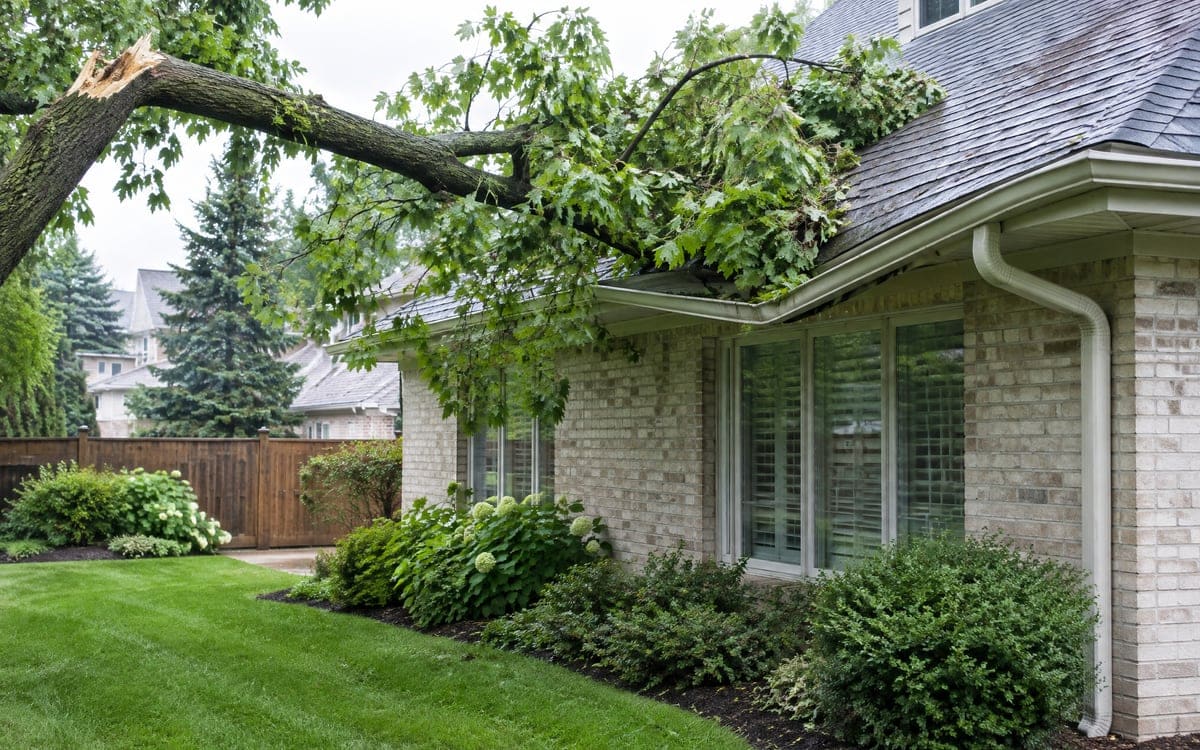
A limb on a roof is pressing on the sheathing underneath; a trunk across a car is bending the metal; a tree against a fence is loading the fence rails. We look at where the weight is going and what will shift when we cut.
Hung limbs in the crown, and a split trunk still standing
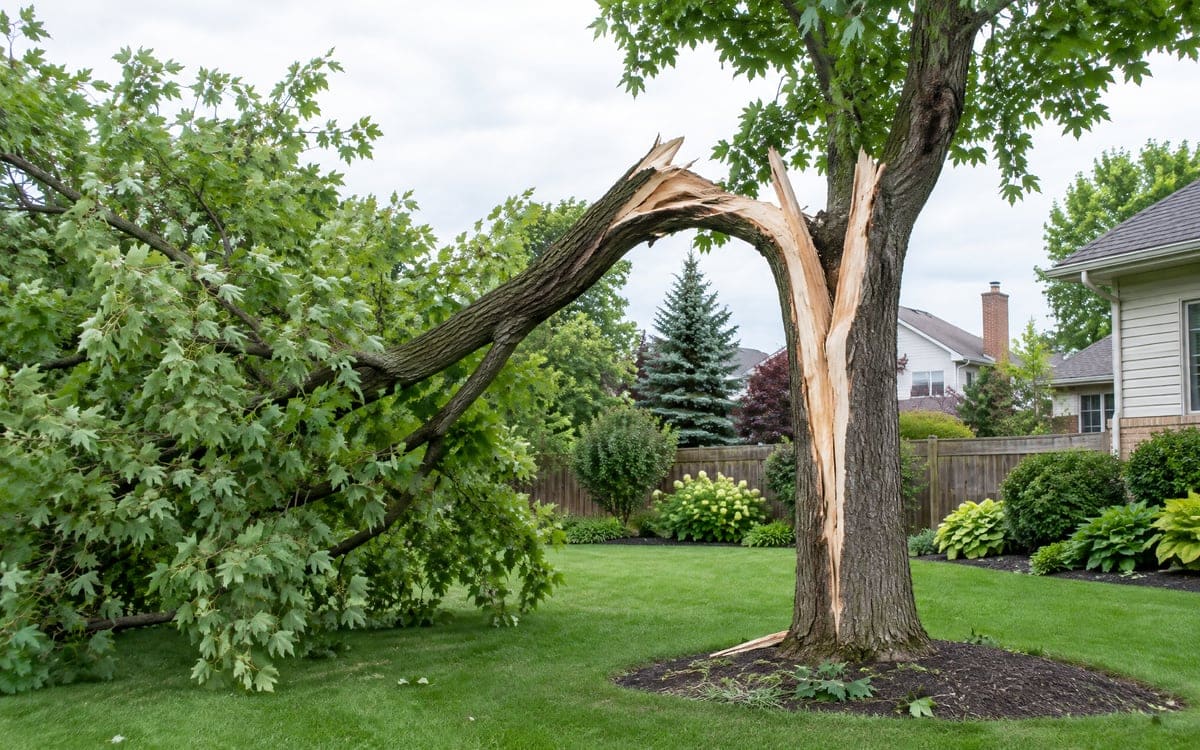
The branch you can see is often not the whole problem. Smaller limbs can hang up in the crown with their ends snapped and their butts caught in a fork. A trunk cracked below the main fork is slow failure in progress, and can give way without warning.
Roots lifted on one side
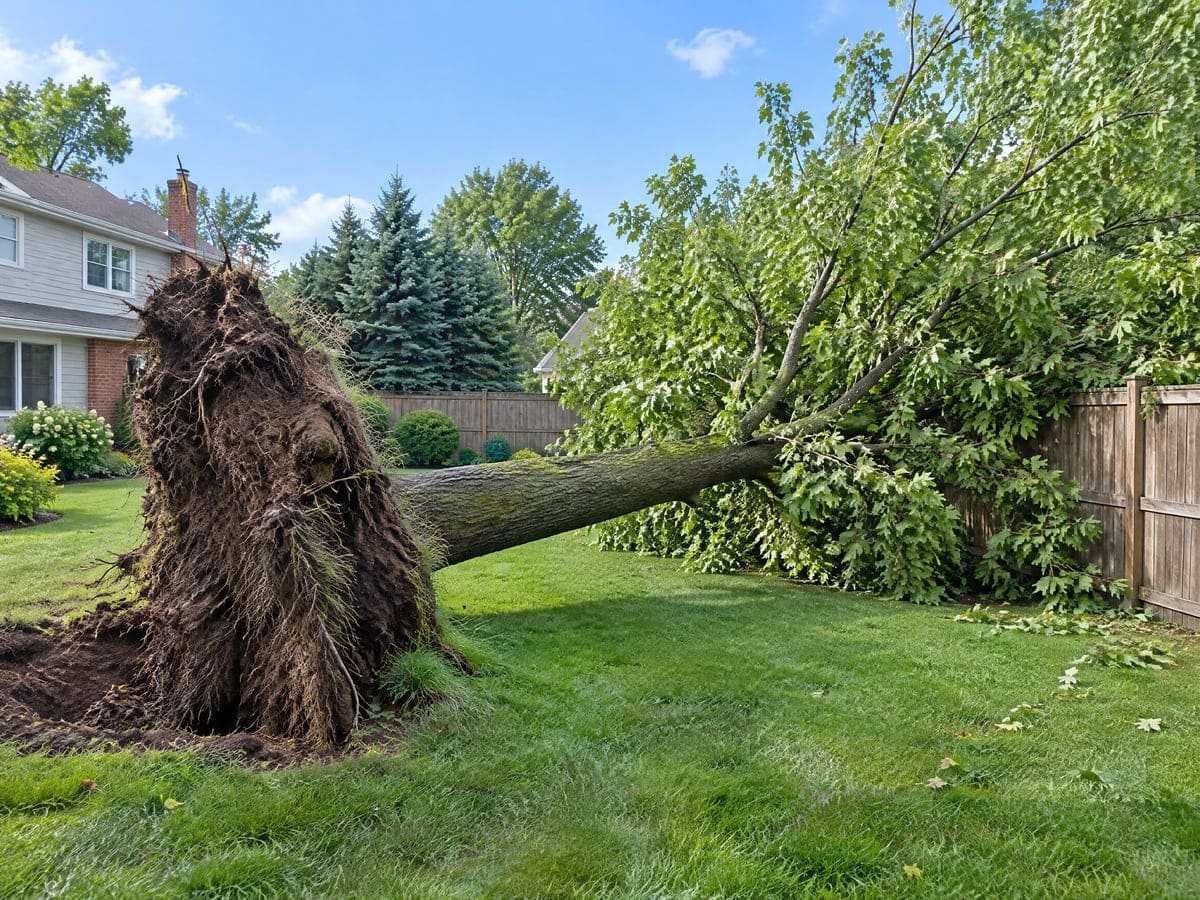
A tree that uprooted part-way shows a crescent of lifted soil or a tilted root plate on one side. Those trees come down the rest of the way without much warning.
What can wait
Not every storm job needs cutting right away. A tree down with nothing under it can wait; a tree still under load cannot.
How symptoms match the usual work
| Symptom | Likely cause | What it usually needs |
|---|---|---|
| A tree down on the roof | Wind, root failure | A sectional removal |
| A broken limb hung up in the crown | Snapped and caught in a fork | Taking the hung limb down |
| A split trunk still standing | A failed union, loaded by wind | Removal, or cabling if the split is small and the wood below is sound |
| A tree across the driveway | Wind, soft ground | Clearing the drive and taking the tree out |
| An uprooted tree with the root plate up | Saturated soil, big wind | Removal; the tree is a hazard where it lies |
| A limb lying on the service wire | Wind, dead branch failure | 911 first if anyone is hurt or a line is down, sparking or burning; otherwise ComEd at 1-800-334-7661; the wood after |
If the tree can be saved with a cable or a careful prune of the broken limbs, see bracing a split we can save or cutting back torn limbs. Otherwise the work is on taking down what is left or, once the stump is left, the stump of an uprooted tree.
Save what is left, or take it down
When the tree still has a future
- Most of the live wood is undamaged and the trunk sounds solid under a mallet.
- The split is a small one at a side branch, and the main stem is intact.
- The crown lost a limb while the main structure stayed sound.
When it should come down
- The trunk is cracked through, or decay has left too little sound wood to hold the top.
- The tree is leaning onto a target with the roots lifted.
- The crown is more broken than standing.
- A dead tree lost its top and the rest is unstable.
From the call to the work
Call (847) 201-4879 and tell us what the tree is doing: on the house, across the drive, hung in the crown. If a line is involved, call 911 first if anyone is hurt or a line is down, sparking or burning, then ComEd at 1-800-334-7661; mention the line on the call to us. The tree gets a read from a safe distance before any work. The storm checklist covers the homeowner side of the first hours.
Storm and emergency tree work in Hoffman Estates
The June 10, 2026 derecho3 brought a tree down onto power lines one mile northwest of Hoffman Estates at 3:39pm, with gusts up to 80 to 85 mph and widespread wind damage across much of northern Illinois. Ice is heavier than it looks, too: heavy ice loads during ice storms can break limbs or ruin whole trees and bring down power lines, and damaging ice storms happen throughout Illinois.4
Illinois tornadoes and thunderstorms in a year
Statewide figures from the Illinois State Climatologist on Illinois tornadoes and thunderstorms.
63%
Of those tornadoes come April through June
60
Thunderstorms a year on average in the far northeast of Illinois
After a storm, ComEd clears its own equipment, but the wood becomes yours: ComEd cuts and removes trees and branches from its own equipment, but disposing of the branches, logs and other debris is the customer's responsibility.1 What the Village picks up and what it does not is worth checking in advance. Branch pickup takes tree branches, shrub trimmings and similar brush up to 8 inches across and 10 feet long, but not stumps, root balls, firewood, lumber, leaves, grass or sod,5 and the free curbside branch pickup runs by zone twice a year; the 2026 spring round began Monday, April 20 and the fall round Monday, September 21, with branches at the curb by 7am on the Monday of the zone's week.5 Smaller brush can go out with yard waste: brush set out with yard waste must be bundled at no more than 50 pounds, 5 feet long and 24 inches across, with no limb thicker than 3 inches.6 For a parkway tree that came down, call Public Works; the Village says residents should not trim parkway trees themselves.7