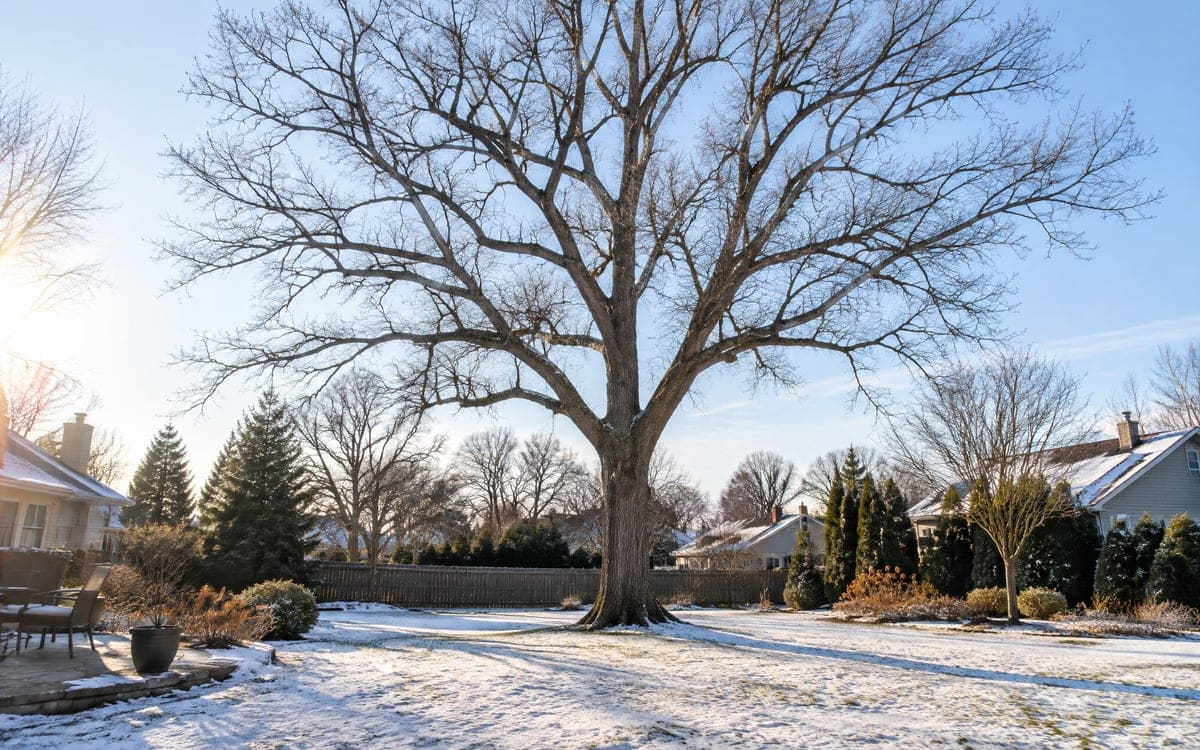
Oaks get their cuts from early November to very early April
The oak calendar is the one that trumps every other date. The Morton Arboretum says oaks should not be pruned between mid-April and mid-October:1 a fresh wound in those warmer months pulls in the beetles that move oak wilt from tree to tree, and the safest window for oak pruning runs early November through very early April.
That window covers both the red oak group (red, black, pin, scarlet) and the white oaks (white, bur, swamp white). An oak that needs structural pruning or deadwood removal in July waits until November unless the limb is already a safety problem. For the pruning work itself once the window opens, see tree trimming.
Oaks and most other trees sit on different calendars
Oaks have one pruning window and most other deciduous trees have another, with oak wilt behind the oak dates.
Oaks
- The safest window to prune is early November to very early April.
- Avoid pruning between mid-April and mid-October, when fresh wounds attract the beetles that carry oak wilt spores.
Most deciduous trees
- The best time is late fall after the leaves drop, through very early spring.
- Avoid late summer, August and September, which can push growth that may not harden off before winter.
Sources: The Morton Arboretum, Oak Wilt; The Morton Arboretum, How and When to Prune Trees (When to Prune Trees tab).
The window is not a rule from the Village. It is horticultural advice, and it has shaped how careful crews work on oaks across northern Illinois. On a private lot with a mature red oak, the same thinking carries over.
A summer wound on an oak draws the beetles that carry wilt
Sap beetles are drawn to fresh wounds during the warm months, and they can carry oak wilt spores from one tree to another. A cut in January leaves no sap-rich wound at the moment the beetles are flying, which is why the dormant window is treated as safe.
Oak wilt can be found in all Illinois counties,1 and trees in the red oak group usually die within weeks or months of infection, while white and bur oaks decline more slowly. Hoffman Estates is inside that range, and the window keeps a healthy oak out of the way of a disease that moves fast once it starts.
One infected oak can reach its neighbors through the roots
Even a careful cut cannot help if the oak next door is already infected. Most new oak wilt infections travel through root grafts1 between oaks that grow within roughly 50 feet of one another, and dead or infected red oaks should come out before they form fungal spore mats.
That is a reason to treat clusters of oaks together. If one in a group is browning in midsummer, an oak lost to wilt is the removal page, and the rest of the group may be worth a close look before any winter cuts.
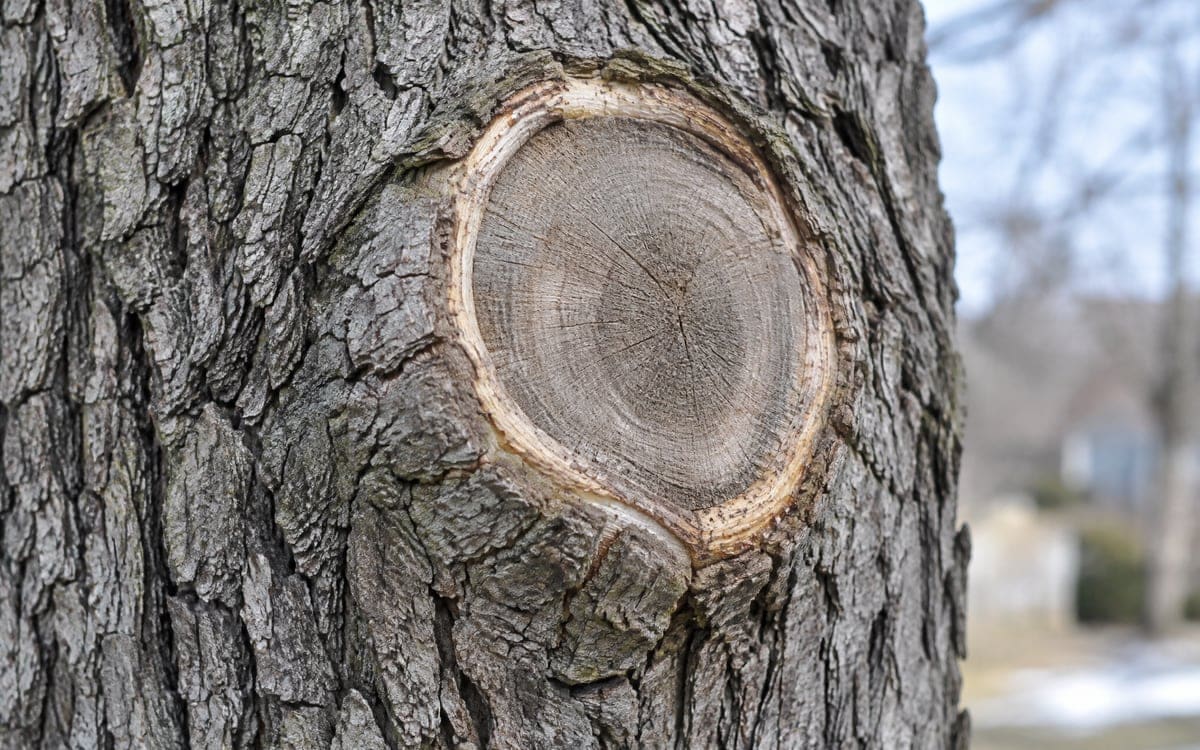
The Village trims its parkway trees in late fall and winter
The parkway strip has its own calendar, and it is not yours to run. Parkway trees are owned and maintained by the Village, with routine trimming every four to seven years, mostly in late fall and winter.2
A resident does not trim a parkway tree. For a parkway oak, the Village's winter cuts are already in the right season.
Bare branches show the structure
A dormant tree with no leaves on it is easier to prune well. The main leaders stand out, the deadwood is obvious against the sky, and the places where two limbs rub are clear. For most other trees (maples, lindens, honeylocust and the like), late winter to very early spring is a straightforward time to work.
Spring and summer cuts are not forbidden on those species. They just take more judgement from the ground, because the leaves hide the frame of the tree. A branch that looks like it crosses another may not, once the wind moves them apart. A branch that looks fine from the patio may be rubbing out of sight behind a cluster of green.
A dormant pruning on a maple or a honeylocust is also kinder to the tree. The cuts seal through the following growing season rather than during it, and most of the tree's energy is still underground when the saw goes to work.
Dead and hanging wood sometimes cannot wait
The one job that does not wait is a limb that is already dead, broken or hanging over something it would land on. A dead, broken or hanging oak limb that is a hazard comes off when it has to, even in summer; routine oak deadwood waits for the early November to very early April window, and the call to cut inside that window is a decision for a tree professional on site.
A limb that broke in a wind event sits in the same bucket, outside the oak calendar. A limb that breaks in July is a storm job, not a calendar one, and the call for a hazard limb on an oak is still a call made at the tree.
Branch pickup sets the homeowner's own cleanup calendar
In 2026, the Village's spring round began Monday, April 20, and the fall round Monday, September 21,3 with branches due at the curb by 7am on the Monday of the zone's week.
Timing a non-oak pruning to fit the week before a pickup round saves the pile in the driveway.
Yard waste stops at the end of November
Yard waste collection runs from the beginning of April through the end of November only,4 with unlimited yard waste on the regular collection day. From December through March, yard waste bins and bundles do not go out.
That is one reason December cuts on an oak either chip on site or wait for a branch pickup round. The Village's rules on bundle size and weight apply the rest of the year, with a 50-pound, 5-foot bundle and no limb thicker than 3 inches inside it.
ComEd works its lines on a four-year cycle
Trees that grow near the lines along the back of a lot are on another schedule. ComEd trims trees and vegetation along its lines on regular four-year cycles,5 with some mid-cycle work where trees grow especially fast, and its contractors prune to the ANSI A300 standard using directional pruning.
If a tree near a line between poles is on the Village side of the fence or clearly in ComEd's path, the ComEd cycle is where it sits. For a tree in your own yard that leans into the lines, the ComEd line clearance options outline the three routes a homeowner can take.
Storm season can rewrite the plan
NWS Chicago's storm reports for the June 10, 2026 derecho6 include a tree downed onto power lines 1 mile northwest of Hoffman Estates, with gusts up to 80 to 85 mph and widespread wind damage across much of northern Illinois.
Winter is not quiet either. Heavy ice loads during ice storms can break limbs or ruin whole trees and bring down power lines,7 per the Illinois State Climatologist. Both are reasons to think about pruning in cycles longer than a season: a tree worked carefully one winter is less likely to shed a leader the next summer.
A pruning calendar for Hoffman Estates
| Season | What makes sense | Source |
|---|---|---|
| Early November to very early April | Oak pruning window; dormant structural pruning on most other trees | Morton Arboretum oak wilt1 |
| Late fall and winter | Village parkway trimming on its four- to seven-year cycle | Village Forestry2 |
| Mid-April to mid-October | No oak pruning except emergencies; non-oak trimming, with judgement | Morton Arboretum oak wilt1 |
| April through November | Yard waste collection on the regular day, within bundle limits | Village yard waste4 |
| Spring and fall pickup rounds | Larger brush and limbs within 8 inches by 10 feet at the curb | Branch Pick-Up Program3 |
| When a hazard will not wait | A dead, broken or hanging oak limb that is a danger, decided on site; routine oak deadwood waits for the window | trade practice |
| On ComEd's four-year cycle | Trimming along distribution lines | ComEd maintenance5 |
| After a storm | Hazard work on damaged trees, outside any season | event-driven |