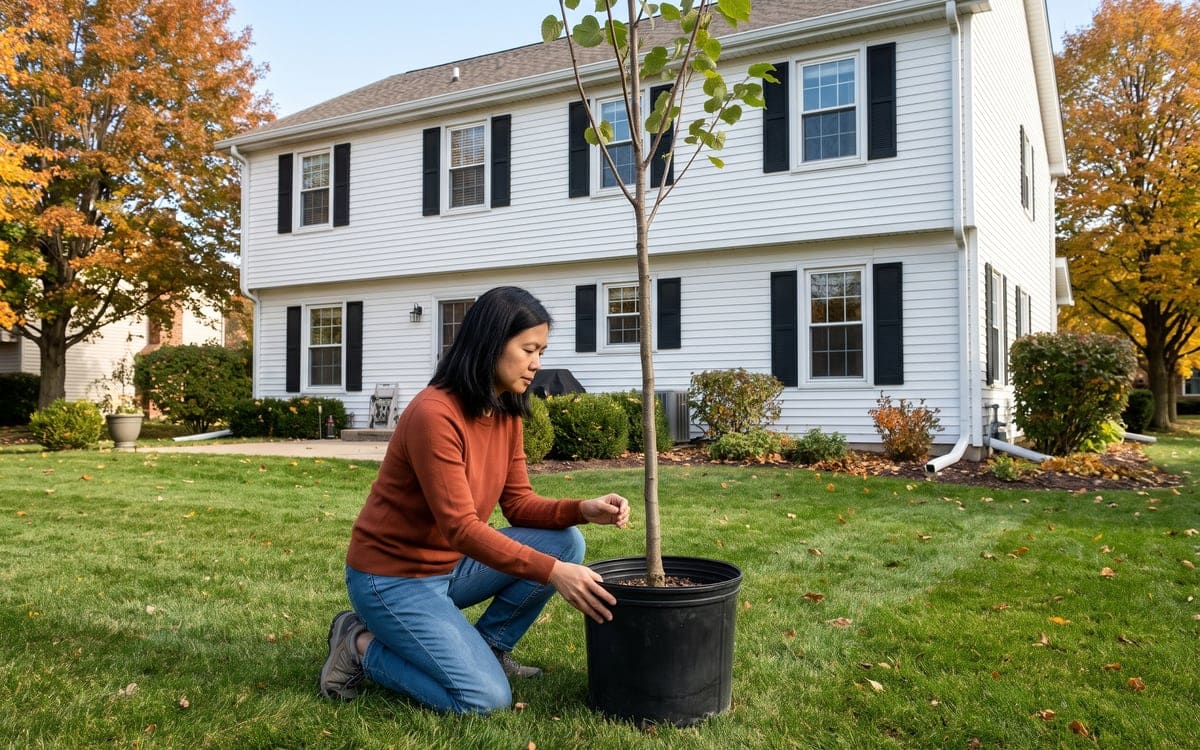
Why fall tree planting works in Hoffman Estates
In autumn, transpiration is low, root generation potential is high, and when the air is cooler than the soil, new roots grow without new top growth.1 The top slows down while the ground is still warm enough for roots to push, and a fall tree can lay down root without spending reserves on leaves.
Northern Illinois gives the window its shape. The average first 32-degree reading in fall is October 7, and the last one in spring is April 28, for an average frost-free growing season of about 160 days.2 The soil keeps working past that first freeze, so a tree planted in the useful weeks still has time before true freeze-up.
The useful window runs mid-August through mid-October
Fall planting, from mid-August through mid-October, offers advantages that may outweigh spring planting.1 The ground is warm, the top of the tree is winding down, and water goes on far more easily in September than in July.
A tree set in September has time for a quiet flush of fresh roots before dormancy. Container stock planted the first week of October is still inside the window, though the margin shortens with each cold front.
Waiting into November runs the roots out of time
The window closes faster than most people expect. Waiting too long into fall, into November or December, risks poor root growth and a higher failure rate; conifers need a slightly earlier start than hardwoods.1
Container stock that misses the window can hold on the yard until spring, kept near the north side of a garage with mulch heaped around the pot and watered when the soil in the pot dries out.
Some trees take a fall planting better than others
Species matter as much as timing. The Arboretum lists trees that can be planted successfully in fall, including maple, linden, hackberry, honey locust, elm, crabapple, hawthorn, Kentucky coffee tree, sycamore, pines and spruces.1 Slow-to-establish trees such as bald cypress, ginkgo, magnolia, sweetgum, tuliptree and willow are better planted in spring.1
| Plant in fall | Hold until spring |
|---|---|
| Maple, linden, hackberry | Bald cypress, ginkgo |
| Honey locust, elm | Magnolia, sweetgum |
| Crabapple, hawthorn | Tuliptree, willow |
| Kentucky coffee tree, sycamore | |
| Pines, spruces |
A ginkgo bought on sale in September is not a mistake. The pot waits out the cold in a sheltered spot and goes in the ground when the soil warms.
JULIE comes before the shovel
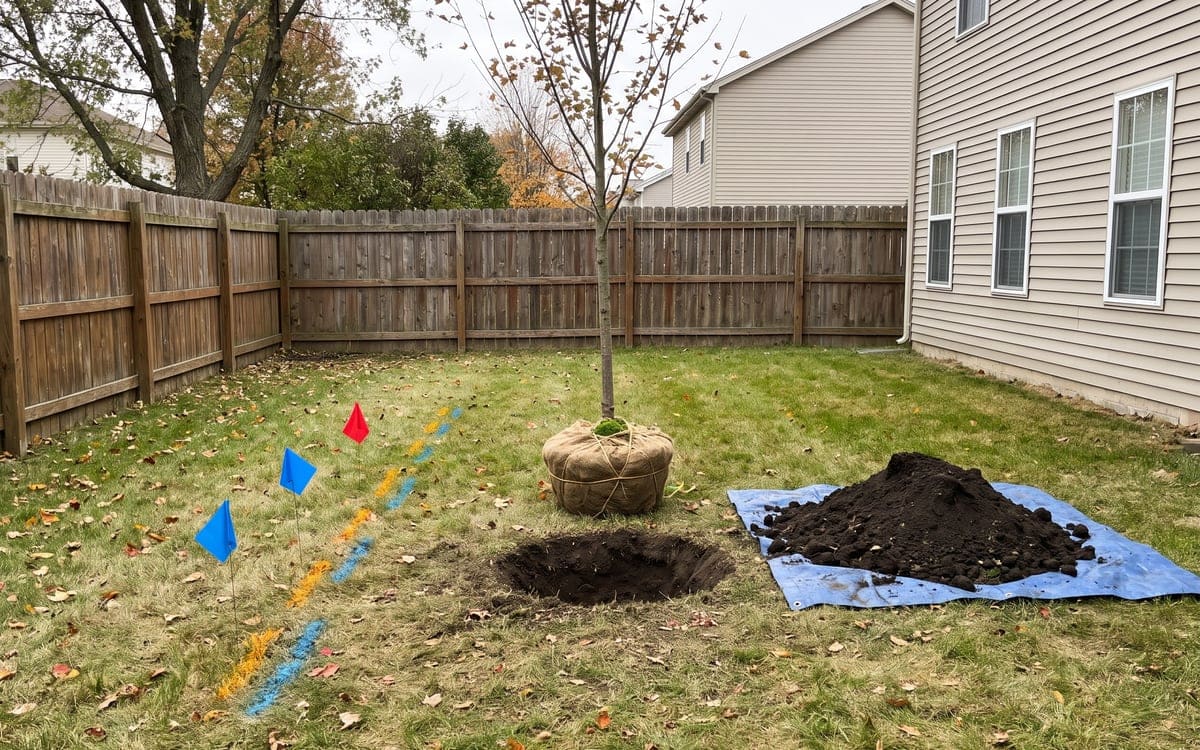
Illinois law requires anyone planning outdoor digging, whatever its depth or size, to notify JULIE at least 3 days before digging,3 even for planting trees and shrubs. The request is free, made by calling 811 or online, and goes in from the person doing the digging,3 not the owner of the yard. A homeowner planting on their own makes the call. The paint and the flags come first; the hole comes after.
Private utility lines in the yard are yours to find
JULIE says utility owners mark only the lines they own. Private lines such as sprinkler lines, private lighting and secondary electric lines to detached garages are not marked3 by them.
The usual list in a back yard is a sprinkler zone, the low-voltage cable to the path lights, the feed to a detached garage, and other private lines not covered by the member utilities. A sketch of where those lines run saves a planting from a nick that costs more than the tree.
Tall trees stay well clear of the ComEd lines
Where the planting spot sits near a line, species comes before the hole. ComEd recommends that trees planted within 20 feet either side of pole-to-pole power lines have a mature height under 25 feet, and that tall-growing trees go 50 feet from the lines.4
A back lot line with a wire running along it is not where a sugar maple belongs. A small ornamental tree is a better long-term match there, pruned by its own habit rather than by ComEd's trimming cycle. A short site assessment sorts out which spots take tall shade and which should stay low.
The old stump sets what can go in the same spot
A new tree does not go into the hole where the old one came out. Root flares, dead wood below grade and compacted soil get in the way of a fresh root system. Grinding the stump opens the ground enough to work with, which is a start on the planting pit, not the whole job.
A planting spot either moves a few feet from the center of the old stump, or the species changes, or both. The chip-and-soil step is covered in the planting-after-removal guide. For a tree still standing in the way of the new spot, removal is the step that opens the ground.
Start the species list with the Village's own
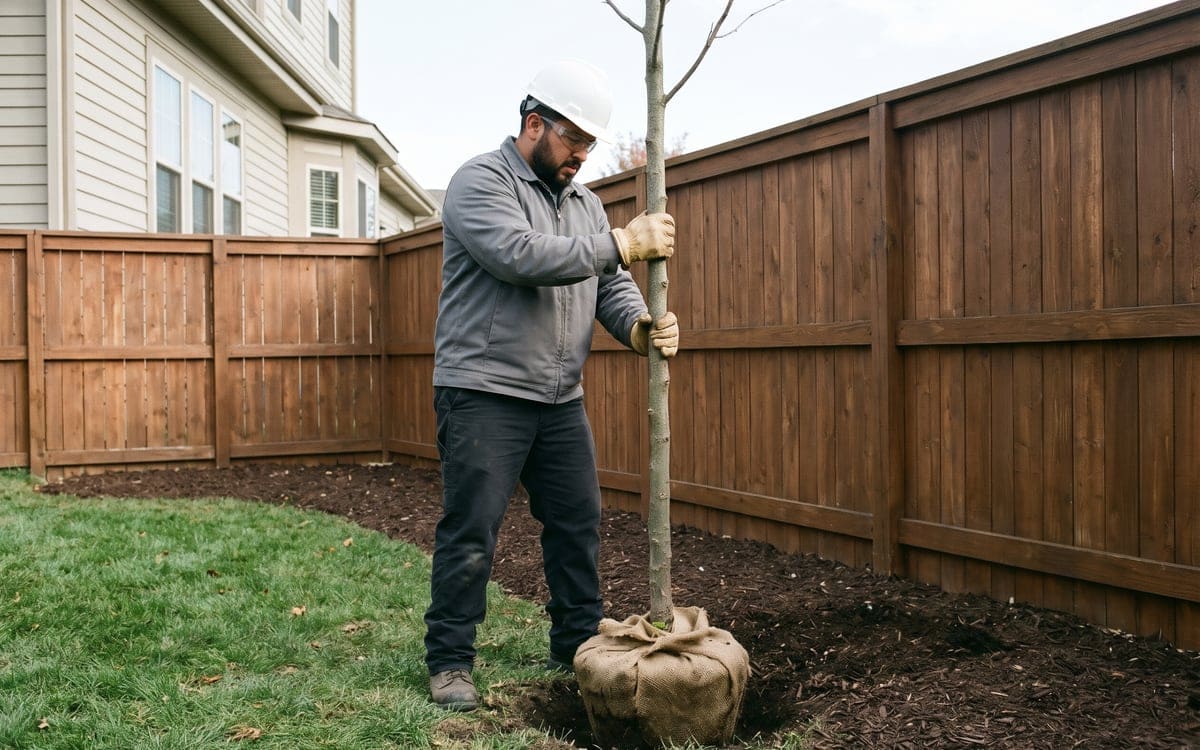
A good shortlist for a Hoffman Estates yard starts with the trees the Village code lists for street planting. The code's list of large street trees includes Freeman, sugar and Norway maples, hackberry, ginkgo, thornless honeylocust, Kentucky coffeetree, London plane, several oaks (white, swamp white, bur, red, chinkapin and others) and lindens, with trees under overhead lines sized so they do not interfere with the lines.5
That list is for street trees, but on a private lot it is a reasonable place to start. Oaks on the list come with their own calendar; the oak pruning window covers when they are and are not pruned. Parkway trees are owned and maintained by the Village,6 so the choice in front of the sidewalk is not yours to make, and the guide on parkway or private covers which side of the sidewalk is which.